Glenn, I have one question. Are the children that are not going to be able to get a ride on the bus to school living in the USA? If not, who is paying the taxes to fund the school that they are attending? If they are living in Mexico, why are they going to school in the US? Lacy
Roy,
Yes, the children live their homes on the U.S. side during the week in Candelaria and these children are U.S. citizens. Their parents who may or may not be U.S. citizens and some are also have residences in Mexico and own or rent houses in Candelaria so the kids may go to school. But the non-citizen parents may not work legally on the Texas side. Renters do not pay property taxes. Anyone who owns property in Presidio County pays the school taxes. Just like in San Angelo where property owners foot the bill for educating the children of renters. The same probably goes for taxpayers in any other place in the U.S.
The children also live in Mexico with their parents on weekends, during the summer or when ever they can. They are going to school in the U.S. to learn English and because their school in San Antonio del Bravo has been closed. There is no other place for them to go to school. The schoolteacher in San Antonio was shot and killed on the steps of the school and no longer operates. This has long been a thorn in the side of the Presidio ISD. The two room Candelaria school became known as the “wetback school” in its century of existence and the Presidio ISD solved their problem by simply closing the school a few years ago. They also closed the Redford school. Now the kids spend more than two hours a day on a bus in order to get an education. This is very hard for them especially the little ones. The Border Patrol today uses the Candelaria school buildings and property as a base of local operations. It costs the school district more money to run the buses back and forth that it did to operate the school. It costs the district the same to pay the teachers in Presidio or Candelaria.
There are no quick and easy answers for all this. The good decent folks on the river do their best to make a living for their families and get an education for their children. The result of the border crossing closing at Lajitas only brought economic ruin to the Mexican town across the river when the lifeblood of the community, tourism, was cut off. The school on the Mexican side at Paso Lajitas closed and the good people had to move away. Now Paso Lajitas is a ghost town, only to the benefit of the smugglers.
Gj
[ 2 comments ] | permalink
There is a great deal of information here on the blog. To access information, you may simply scroll down to find the history and Mexican border news articles but since there is so much here this can be tedious. A to get a better idea of what is here, click on archives then when the next archives page comes up, click on show all. When you do this you will get a complete list of all the articles with a synopsis making it easier to access more than three years of work. Another trick is simply to use the search box. If you want to find, for example, info on the Porvenir massacre just type "Porvenir". If you want the latest news on the Candelaria bridge issue just type "Candelaria".
Also, several folks have questioned the numbers on the hit counters. The hit counters do not work. At peak times, Glenn's Texas History Blog is read by up to 200 different urls in a few hours. Recently, the blog has crashed because of so many hits. Please feed free to post your comments or questions. Let me know if your are having problems posting by clicking add comment. Also, with the recent software upgrade so I may post photos, the most recent comments does not work on the side bar.
You may also simply have your comments and questions posted by clicking on contact me, emailing and I will post. Your comments are most appreciated and I encourage you to comment. I have a growing number of requests for research help and will respond as soon as I am able. All of those emailed to me are on the list and I will respond with a post of answers and help, so please be patient and check back on the blog for your answers and help.
Gj
[ add comment ] | permalink
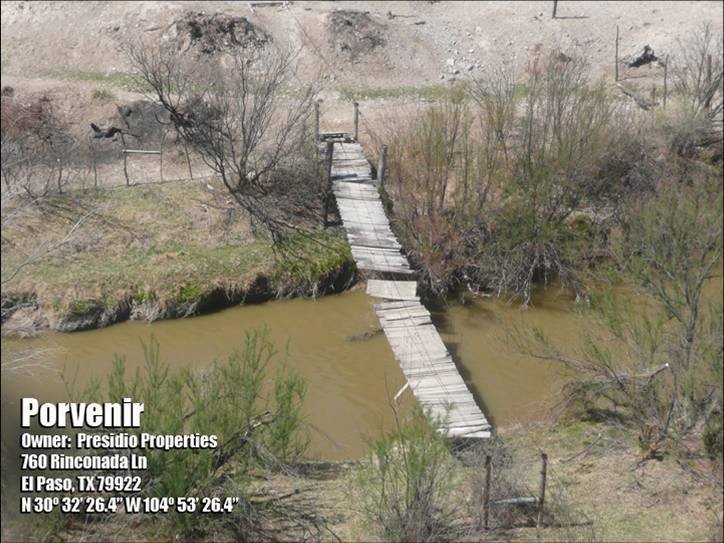
According to the latest reports, the little footbridge shown above at the Porvenir/Pilares crossing of the Rio Grande is next on the Border Patrol removal list. The Border Patrol is requesting landowners on the Texas side tear the bridge down. Below is landowner Fred Nelan's response to the Border Patrol.
Gj
From: Fred Nelan
Sent: 05/30/2008 10:01 AM
To: 'REYNOLDS, LORAINE L'
Cc: 'perelpowell@aol.com'
Subject: RE: Porvenir Footbridge
To: Loraine L. Richards
Patrol Agent in Charge
Marfa Border Patrol Station
(432) 729-4250 Office
Hi Lorraine:
After our conversation this morning I would like to reduce to writing in this email the facts that I conveyed to you. First of all I don’t believe that the bridge in question in Section 65 belongs to us. I therefore will not be destroying it this weekend as we discussed late yesterday.
It seems that congress authorized in 1972 the funding for channeling of the Rio Grande as well as preservation of wildlife on the river. This was in accordance with some Treaty with Mexico and they were to do a similar project on the other side of the river. It appears that many surveys were then conducted as well as environmental impact studies were done. In the early 1980’s the International Boundary and Water Commission (IBWC) began executing the project and acquiring right of way and lands for wetland set aside from landowners with river frontage. We were owners of the subject land at the time and a 200 foot right of way was acquired from land owners between a place called Haciendita on the South and North to Fort Quitman. We received compensation for some 47 acres in this right of way for our river frontage and assume most other land owners did also. The frontage on our Section 65 as well as a small piece of Section 66 was identified also as wetlands. We were compensated for 23 acres and the IBWC took title to this land.
It appears to me that since our land in Section 65 does not touch the Rio Grande at any point ,and what does touch is owned by IBWC, then the bridge is not our responsibility.
As I told you I have extensive files on this matter with maps and plans supporting the whole project including the environmental assessment. These files should be available to you from sources other than from us. I will deliver these files to our Attorney and partner and you can communicate with him regarding these files. He is Robert Perel and he has sent you a letter recently that on the letterhead will appear his contact information.
On a personal note I would hope that somewhere in this great government of ours someone can help alleviate the hardships you are about to impose on a few law abiding US Citizens living in San Antonio de Bravo. Removal of the Candelaria bridge to stop terrorists and Drug smugglers as well a few illegal aliens from crossing is ludicrous . They don’t cross there anyway. Those illegal aliens that do cross are not the ones that are headed into our heartland and are so controversial but they are part of family and culture of our great Rio Grande Valley. We need to allow their children to catch that school bus in Candelaria each morning.
I write this as I see the new wall under construction over the sand hills west of El Paso. It is going down the Border on its way to California. I was raised here in El Paso and it breaks my heart to see such things happening.
Fred
[ 1 comment ] | permalink
Once again it is happening at Candelaria. Nothing-new when innocent law abiding folks come under the gun of politically motivated military style repression. Fear and intimidation is always the common element and the bad guys end up smiling. This comes as no surprise to those of us who study and interpret the past on a daily basis. A drug war in Mexico has again brought the powers of the U.S. government to make ill informed border policy decisions that simply make matters worse to the considerable benefit of lawbreakers.
Candelaria is a tiny remote Texas-Mexican border village located in the rugged Presidio Valley of the Big Bend. A muddy stream known as the Rio Grande River separates Candelaria from San Antonio del Bravo, Chihuahua. Very few outsiders understand that these are not two separate villages; they are simply one community with a sluggish stream of water in the middle. The problem is, however, the watercourse has been an international boundary since 1849.
The Candelaria/San Antonio community has been in existence for centuries. The original inhabitants were people the Spanish called Jumano. In the early 1500’s, when the Spaniard Cabeza de Vaca made his way through the Presidio Valley he was the first European to observe these peaceful but resilient farmers and traders who depended on the Rio Grande to exist. But the Jumanos were anything but peaceful when it came to defending their lives and homes from outside intrusion. The Spaniards brought the horse and about half a century after Cabeza de Vaca began introducing military solutions to dominate the land and enslave the people. The Spaniards were not the only outside intruders. When the Pueblo Revolt of 1680 took place other Native American groups from far away became mobile on the horses the Spanish brought. Empowered Apaches and Comanches came to raid and steal and the Jumanos fought back as best they could.
In 1848 the Mexican War resulted in the Treaty of Guadalupe Hildago and the watercourse in Candelaria and San Antonio became an international boundary. Suddenly the United States acquired most of the northern lands of Mexico when the despot Santa Anna cheaply sold out his country to save his hide. Having little knowledge of their new land, the U.S. government launched an era of exploration and mapping. In 1849, Lieutenant William Henry Chase Whiting set out to discover and map a practical wagon route between San Antonio, Texas and El Paso. In the spring of the following year, he entered the Presidio Valley and passed through what we know today as Candelaria/San Antonio del Bravo. Fortunately for Whiting, the native inhabitants of the community had moved into the Sierra Madre to escape the searing summer heat. Had he arrived a few months sooner his scalp might well have ended up swinging in the wind from a lodge pole. Now Candelaria/San Antonio was on a map.
About 1881, the Candelaria Catholic church received a new bell. Sometime after that, Candelaria got a school. In 1901 Candelaria post office opened and a store serving the needs of a vast area of Texas and Mexico began to prosper. You could buy groceries, beer, hardware, clothing, gasoline, guns and ammunition. In those days, the Rio Grande flowed wonderfully and farming in the Presidio Valley offered new hope of better times. Cotton farming was introduced in the valley and good water and high cotton prices fueled the establishment of cotton gins. Candelaria had two gins and soon a two-story hotel complete with a barbershop. There was also a saloon and billiard parlor. The 1910 Census counted 543 residents of Candelaria. Also, in 1910 a revolution, the first great revolution of the twentieth century, brought war to Mexico. Landless peons, small landowners, merchants, artisans and tradesman took up arms and followed leaders like Pancho Villa into battle. Isolated in Chihuahua, Villa depended on the Mexican border for a steady flow of arms and the materials of war. An arms for cattle trade fueled Villa’s armies. More than a million people died in this war. Border raids into the Texas Big Bend brought the U.S. military into the picture. Candelaria merchant J. J. Kilpatrick pleaded for help to defend his town and in 1917 the Eighth Cavalry built a new border outpost overlooking Candelaria. Most of the people moved away to escape the violence. Fear was everywhere. Not many bandits or outlaws got caught and the military ran roughshod over a lot of harmless peaceful people in the Presidio Valley. The military didn’t stay long and departed Candelaria in 1919 after U.S. cavalry galloped across the Rio Grande at Candelaria drawing more innocent blood during the last American punitive expedition into Mexico.
There have been smugglers plying their illegal trade since the Rio Grande became the border. Without the designation of the Rio Grande as an international boundary smuggling could not exist. From the beginning of the twentieth century smugglers have trafficked a variety of items including prohibited liquor, guns and ammunition and more recently people and drugs. In the early 1980’s, the U.S. government managed to drive the Columbian cartels out of south Florida to the Texas Big Bend. Drawn by the remoteness of the Big Bend, the drug smugglers prospered bringing their loads into the United States. Today in Mexico there is a new war being fought. The drug war is fueled by an arms for drug trade.
As the Mexican drug lords struggle to control their turf across the river, a wave of immigration has come to the forefront of American politics. Again we hear calls to militarize and close the border. Some demand a wall be built between the United States and Mexico. It’s a simple but poorly thought out solution to a very complex issue. Just recently a powerful someone in Washington found out about that Candelaria still has a bridge and ordered it immediately removed. Few have really considered the impact of tearing it down. When the Border Patrol closed the crossing at Lajitas a few years ago, the action resulted in the economic death of Paso Lajitas the little village just across the river. Tourists no long came, the restaurants went out of business and the school closed. There was no work for anyone, the people moved away, and the town became abandoned. Today there are no watchful eyes of good people living there and the smugglers have the perfect vantage point watch the Border Patrol coming and going across the river.
With the little footbridge at Candelaria gone, both towns will wither. The closing the border will devastate the local economies on both sides of the river. Children cannot go to school, good people who need their jobs will have no work. The San Antonio medical clinic will have no way to call for help. There will be nobody to work cattle or fix fence on the ranches. And this only plays into the smugglers hands giving them an empty abandoned countryside to operate in unobserved. The Border Patrol comes, the smugglers stay on the Mexican side, the Border Patrol leaves, the smugglers cross and go about their business. And who is hurt worst by this? Good and decent people who deserve better treatment and more understanding. And the fear and intimidation continues.
Gj
[ 2 comments ] | permalink
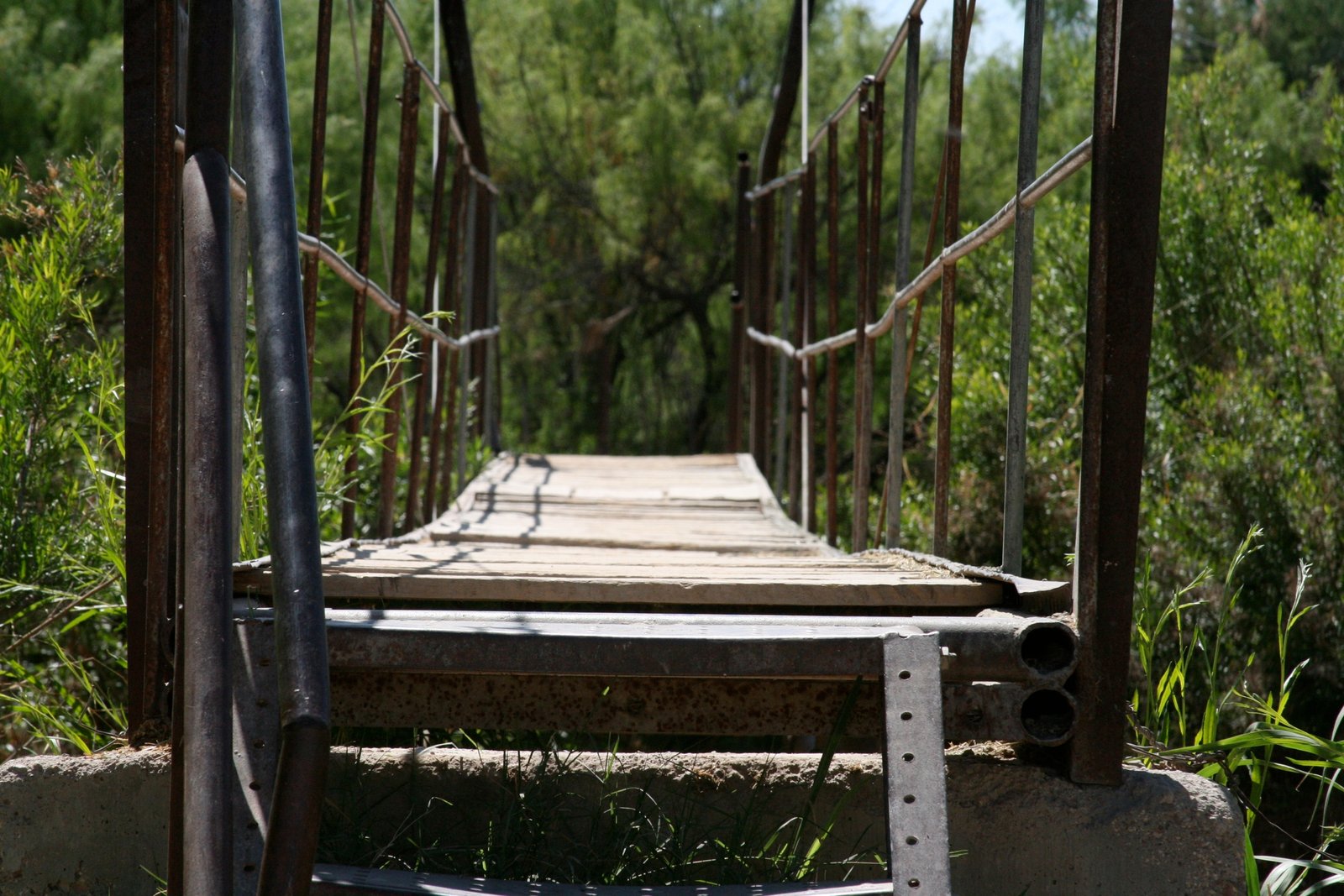
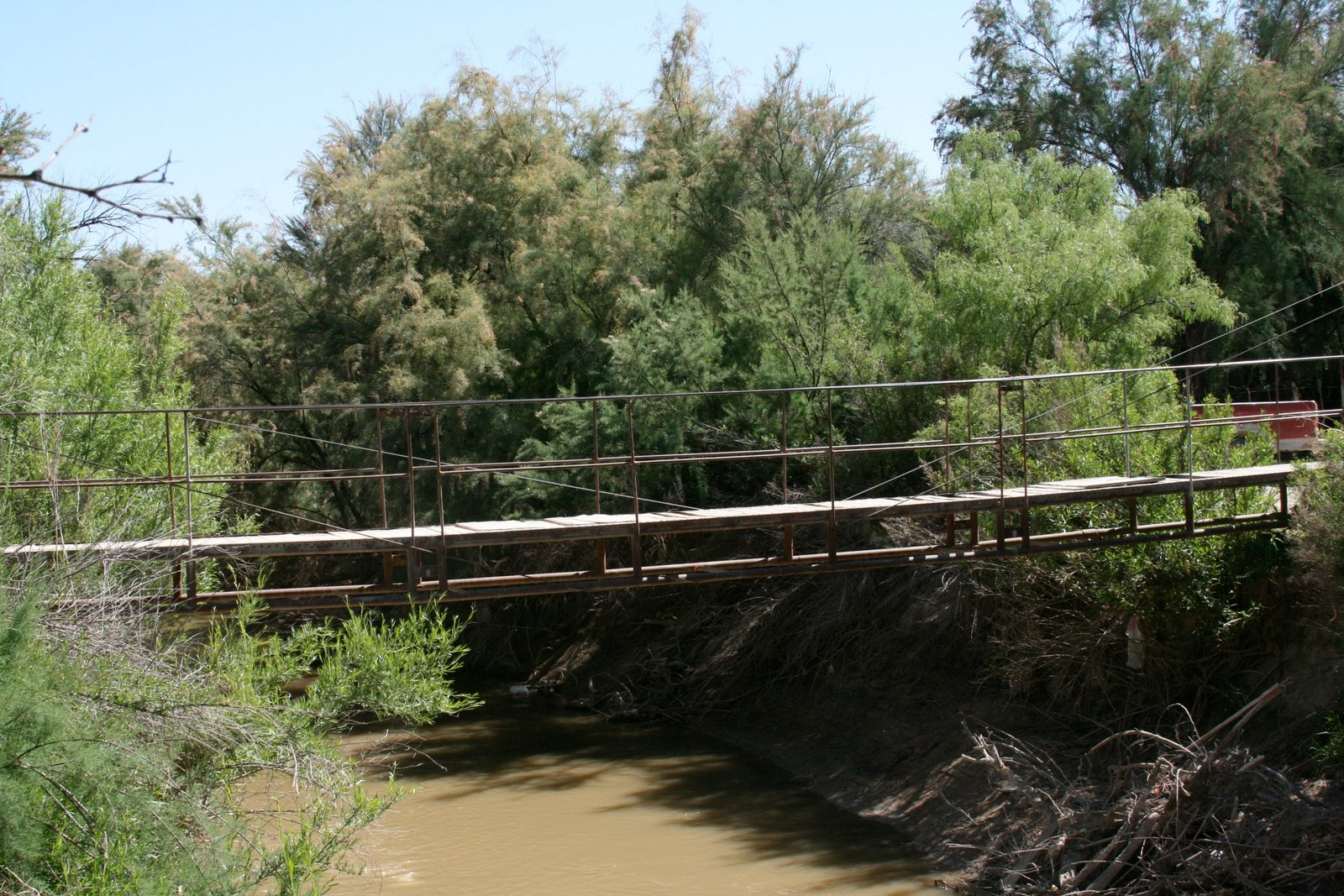
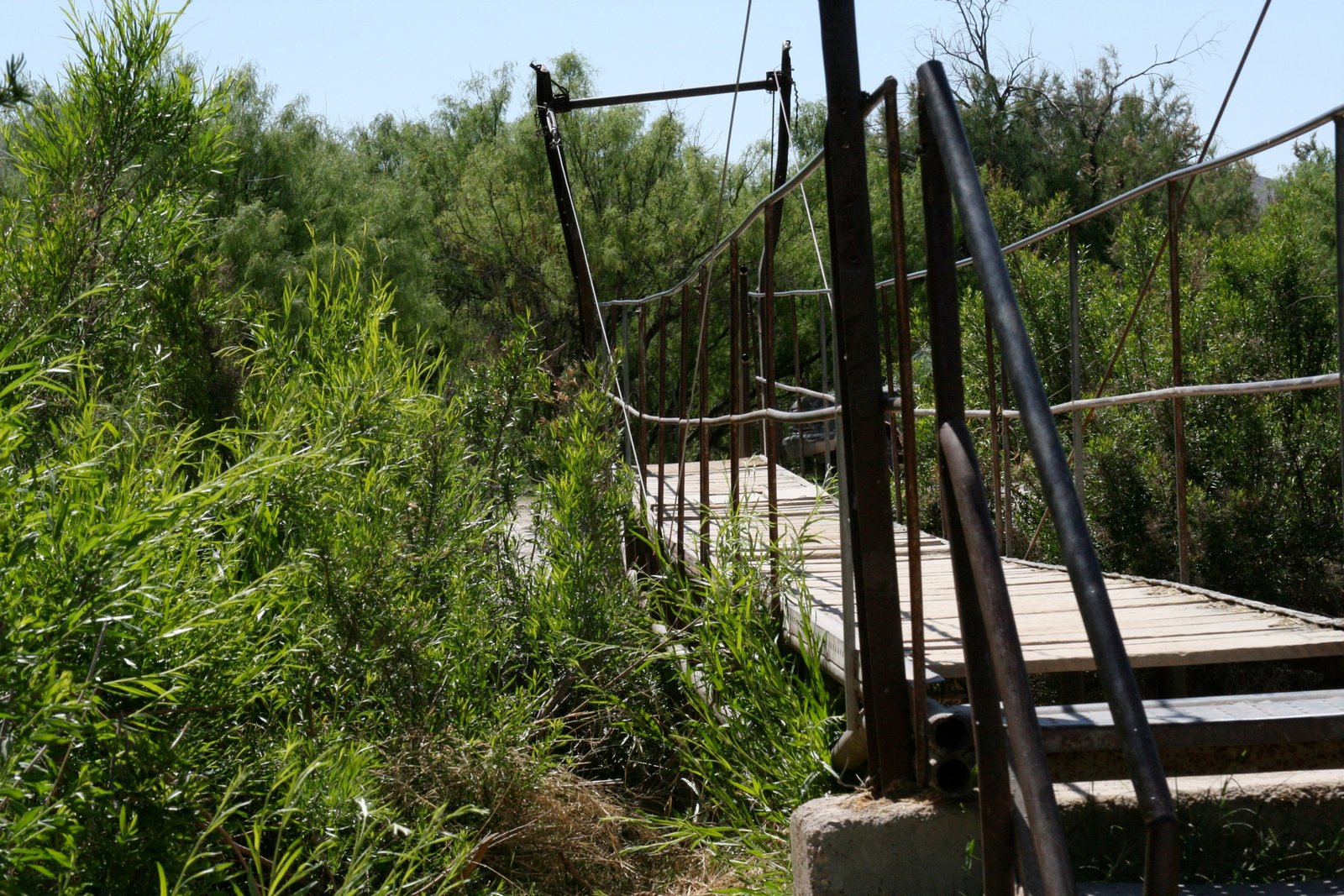
The below photos of the Candelaria footbridge have been graciously provided from Clara Long for Borderstories.org. Thanks Clara! Gj
[ 1 comment ] | permalink
Some blame individual United States Border Patrol agents for the recent order to destroy the Candelaria, Texas, footbridge across the Rio Grande. This may be misleading. The removal order probably came through a maze of bureaucratic channels before reaching the desk of Sector Chief Smietana at Marfa; nevertheless, the harm that could result from the fulfillment thereof remains ominous. Border residents in the Chihuahuense village of San Antonio del Bravo as well as the several hundred United States citizens who reside in and near Candelaria will be adversely affected should access via the footbridge be denied. Moreover, a bridge closure will result in an exodus of la gente to more populous areas such as Odessa, Texas, and Ojinaga, Chihuahua. The Red Sea never parts for the poor and dispossessed. Such an out-migration from the already sparsely-populated desert would be advantageous neither for the families involved, for the region itself, nor for the stability of the receiving cities.
One wonders, then, whether there remain any lawyers willing to work pro bono, that is: “without compensation for the public good.” The myriad of large landowners in southern Presidio County, mostly distant city dwellers with no traditional or familial connection to the region, may care little about the bridge issue; regrettably, certain of them may even favor it. Certainly folk who reside along the Rio Grande, most of whom bear Hispanic surnames, cannot afford to pay astronomical legal fees. Therefore, so much for Equal Justice Under Law, the famous motto engraved over the portico of the United States Supreme Court. “Equal Justice,” is obviously reserved for those who can afford it.
A lawsuit defending the rights of traditional Candelaria residents, perhaps class-action in scope, timely filed, could result in an injunction that would stop enforcement of the Department of Homeland Security’s order for removal of the bridge. In other words, it would buy time. It seems certain that by early next year the Washington power structure will have shifted. Then this supposed “problem,” exacerbated by politicians who know nothing about acculturative factors at work along the “forgotten Rio Grande” may, like a votive candle, have melted away.
The question at hand is more profound than it first appears to be. Consider history: first, the displacement of Mexican-origin people along the Rio Grande border that began with choplogic interpretations of the Treaty of Guadalupe Hidalgo (the Treaty) in 1848-49 (signed by both countries on February 2, 1848). Second, takeovers and outright swindles, often under coverture of interpretations of the Treaty, Article X (land grants), beginning in the “Magic [lower Rio Grande]Valley” of Texas a century ago; acquisition by sale, the Gadsden Purchase of 1853 for example; another, under the heavy hand of vengeful White ranchers and their agents, those being certain companies of bloody-minded Texas Rangers (the Porvenir Massacre comes to mind); the pandemic of Spanish influenza in 1918 during which 3% or more border dwellers of Mexican-origin died; or as cannon fodder in a series of twentieth-, and now twenty-first century “rich man’s war, poor man’s fight” scenarios, and otherwise since 9/11 under the guise of “Homeland Security,” (a catholicon if ever one existed).
One thing seems certain. If something isn’t done to stop the accreting vacantness of the Chihuahuan Desert in the United States above Terrell County, Texas, the region will become a desplobado, or “no man’s land.” Several centuries of progress for the area will be ended and the process of acculturation brought to a standstill. If that’s what a handful of people really want, then shame on them.
Glenn Willeford
Alpine, Texas & Cd. Chihuahua, Mexico
[ add comment ] | permalink
In a strange turn of events Chief Patrol Agent John J. Smietana, Jr. of the U.S. Customs and Border Protection on May 20th. Fed Exed the following letter demanding Fred Nelan of the Coal Mine Ranch tear down or block the Candelaria footbridge in 60 days. While Fred is an owner of the Coal Mine Ranch, he owns no property on or near the river at Candelaria or has anything what so ever to do with the bridge.
The letter reads as follows:
300 Madrid Street
Marfa, TX 79843
U.S. Customs and Border Protection
May 20, 2008
Presidio Properties
760 Rinconada Lane
El Paso, Texas 79922
To Whom It May Concern
The purpose of this letter is to request that you facilitate the U.S. Border Patrol’s enforcement duties by removing the bridge on your property near Candelaria, Texas that spans a channel of the Rio Grande or securing it so that no one can cross illegally from Mexico into the United States. Title 8, United States Code, Section 1357(a) authorizes Agents to enter upon private lands located within 25 miles of the border without a warrant to pursue the investigation of illegal activities. Your property is within that 25-mile area and due to the close proximity of your land to the border, it is likely that unlawful entries into the United States occur on your property. Because we must prevent the illegal entry of terrorists, aliens and/or drug traffickers into the United States, I am asking that your assistance to either remove the bridge or at the very least, secure it so that no one can cross over from Mexico into the United States.
Based on patrolling activities of Agents in the area, it is known that numerous people cross illegally into the United States in the area of Candelaria, Texas. Therefore, within the next sixty days, please initiate measures immediately to secure, seal or completely remove the bridge from your property to ensure that you are not aiding and abetting these individuals illegal entry into the United States. See18 U.S.C. 2 (“Principals”); see also 8 U.S.C. 1321 (“Prevention of Unauthorized Landing of Aliens”), 1324 (“Bringing In and Harboring Certain Aliens”), and (“Aiding or Assisting Certain Aliens Aliens to Enter the United States”).
We appreciate your assistance and will continue to avoid interference with any rights you have with respect to your property. Our goal is to work with all persons who live along the border in a peaceful and cooperative manner. As discussed above, however, we cannot allow your bridge near Candelaria, Texas to provide as a means for people to illegally enter the United States.
If you have any questions, please contact Loraine Reynolds, Patrol Agent in Charge, U.S. Border Patrol, Marfa Station, Marfa Sector, at P.O. Box I (300 Madrid St.), Marfa, Texas, 79843 or via telephone at (432-729-4250. We look forward to your compliance and support of our law enforcement mission.
Sincerely,
(signed)
John J. Smietana, Jr.
Chief Patrol Agent
cc: Asset Forfeiture Office
A. U.S.A. James J. Miller, Jr.
The above only leaves Fred and a lot of us wondering what in the world is going on. How is this achieving the Border Patrol's stated goal to, "work with all persons who live along the border in a peaceful and cooperative manner"? Gj
[ add comment ] | permalink
Some years ago, the Border Patrol closed the Lajitas crossing. The effects were terrible on the good and decent local people just across the river. Please take a look at the Borderstories.org film: http://borderstories.org/index.php/laji ... ssing.html
Gj
[ add comment ] | permalink
April 19, 2008 -- The footbridge between Candelaria, Texas and San Antonio del Bravo, Chihuahua may be one of the last “informal” crossings along the eastern U.S.-Mexico border.
The two communities connected by the bridge, which crosses a diminutive Rio Grande on gapped wooden planks suspended by repurposed car chassis, are situated, literally, at the end of the road.
Texas Highway 170 dissolves into rough dirt ranch tracks at Candelaria, leaving the river unaccompanied by road for a 200-mile stretch upstream known as the forgotten Rio Grande. On the other side, San Antonio del Bravo is a bumpy three-hour ride on an unmaintained dirt road from Ojinaga, a bustling outpost for Mexican ranchers.
Dr. Maribel Aquino, 32, works alone in San Antonio del Bravo’s rural medical clinic with no phone or internet connection. She describes how the majority of San Antonio’s women and children spend the week in Candelaria in order to send their American-born children to the school in Presidio. San Antonio del Bravo’s schoolhouse sits empty; most women in the community decide to give birth across the border so that their children become American citizens.
A sign near the footbridge advises crossers that it is illegal to enter the United States at Candelaria, but residents of the community say the warning is un-enforced. If it were, says Dr. Aquino, the community would not survive.
Borderstories.org
www.borderstories.org
[ add comment ] | permalink
Few outsiders really understand the impact of the Departmant of Homeland Security's order to tear down the Candelaria bridge. The only nearby medical clinic is at San Antonio del Bravo just across the river from Candelaria and the bridge is a vital link to many of us who never know when we need medical care. Please take a minute and view the excellent short documentary film by borderstories.org concerning the bridge and the clinic.
http://borderstories.org/index.php/san- ... ctora.html
Gj
[ 2 comments ] | permalink
To Congressman Ciro Rodriguez: subject, the recent Homeland Security ordered dismantling of the suspension footbridge across Rio Grande at Candelaria, Texas, in Presidio County.
Sir, we met at Rocksprings, Texas, a few months back when you graciously attended the homecoming for former Edwards County Deputy Sheriff “Gilmer” Hernández after his release from federal prison for “violating the civil rights” of a fleeing violator. You will recall that Hernández shot at a tire on the suspect vehicle in an effort to protect himself and do his job.
Permit me to now express dismay at the short-sightedness being displayed by bureaucrats in Homeland Security. The isolated, economically-depressed region situated forty-odd miles upriver from the Presidio (Texas) Port of Entry has long been a point of acculturation between people of both Mexican and United States origin. One of the factors that have made this interaction possible has been the footbridge which was built by folk of both countries many decades ago at no cost to taxpayers. Candelaria faces San Antonio del Bravo, Chihuahua, a poor Mexican community which has relied upon its connection with the United States in order to survive for more than a century. Everything from sending and receiving mail, making store purchases, summoning help or ambulance services in an emergency up to attending school has been dependent upon the availability of la puente twelve months a year no matter what the weather.
There is no evidence that any Arab terrorists have ever or would ever enter the U.S. at such a place. (If they did, the locals would probably save both governments any trouble and take charge of the matter in their own quiet way. Besides, Canada and Logan International and JFK work better.) Smuggling, always a problem along any border, will not be stopped by removing a one-lane suspended footbridge. What will be stopped, or at minimum greatly interrupted, are the current incessant opportunities for cultural interchange and a significant amount of legitimate commerce that depends upon year-round access a el otro lado.
I ask that you become involved in stopping this untoward effort to further drive a wedge between the people of neighboring nations who want nothing more than to be friends and partners in progress.
Glenn Willeford (historian and novelist)
Alpine, Texas and Cd. Chihuahua
[ add comment ] | permalink
Recently the Department of Homeland Security sent a letter to the Candelaria owners demanding the little foot bridge across the Rio Grande be removed. Details are sketchy but the owners met with federal agents to discuss their concerns about tearing down the bridge. One report I have heard says that at least one of the owners vehemently opposed the action. Homeland Security agents simply replied that Washington officials have only recently learned of the existence of the bridge and issued orders to have the bridge destroyed. The footbridge has been in existence for many years and is a vital link between the two communities of Candelaria, Texas and San Antonio Del Bravo, Chihuahua. It was built by folks from both sides of the river in a community effort. It should be obvious that tearing down the bridge will accomplish little except causing an extreme hardship on good, honest local people who need the bridge so that they can get their mail, gasoline, groceries and send children to school. Anyone interested in opposing this thoughtless, politically motivated action should speak out now. I am told that U.S. Representative Ciro Rodriguez might be willing to take up the cause. Please contact him at: http://www.rodriguez.house.gov/
Gj
[ 1 comment ] | permalink

MISDEMEANOR, n. An infraction of the law having less dignity than a felony and constituting no claim to admittance into the best criminal society.
Ambrose Bierce, The Devil's Dictionary
War is fertile ground for the creative mind. In 1913 a writer who had experienced the American Civil War came to Chihuahua in order to see more bloodshed, this time in the Mexican Revolution. The two conflicts were similar in nature. Had Ambrose Bierce survived his visit to Mexico he would, no doubt, have written some gripping literature about Mexican warfare. But he did not survive, and his literary legacy does not extend beyond his retirement from journalism in 1913. Who was Bierce, and what brought him from the safety of a comfortable retirement to the battlefields of the Mexican desert? To answer the question, one must understand what events made the man, especially his service as a soldier.
Like the Mexican revolution, the American Civil War was a conflict between paisanos, or countrymen. It was fought because the southern states, which were agricultural areas, and the northern states, which were at the forefront of the Industrial Revolution, could not agree on a central power structure for governing the country. The South believed in the autonomy of the state. In other words, they believed that the federation of the states was intended solely for economic and military protection in time of emergency; they felt that Washington, D. C. had no right to tell the individual states how to govern themselves. Southerners felt so strongly about it that they believed their home states, such as Texas, Virginia, or Alabama, to be their countries rather than the United States of America as a whole. One issue that became especially important was the future of negro slavery on the North-American continent. The agricultural South, with its huge cotton plantations, felt that it could not function without the inexpensive labor that was provided by slaves. Consequently they did not want the northerners interfering with their "states rights" through Legislative or Presidential mandate.
The North, on the other hand, had about four times as many people as the South, and most of them were willing to work at low-paying jobs. Slaves, therefore, were not needed and the intellectuals and religious leaders of the North could speak out against the institution of slavery without fear of reprisal from the industrial elites. And speak out they did! By 1861, when Abraham Lincoln became President, the South could see the direction in which the country was moving. Slavery would not be permitted in any of the newly recognized states. In the southern mind, Lincoln's presidency signaled the end of their way of life. Ultimately war broke out when South Carolina militia units cannonaded Fort Sumter, in Charleston harbor, in April; it did not end until 1865 when the South surrendered, but by then about 600,000 Americans had been killed in battle. From the standpoint of casualties, the Civil War was the most horrific war ever fought in the Western Hemisphere. That had been Ambrose Bierce's war. The experience, including a head wound suffered personally, helped to mold the man into a misanthrope as well as a composer of darkly realistic literature.
It is therefore interesting that Bierce, who was 71 years old at the time, came to Chihuahua in order to observe the Mexican Revolution. In fact, he seems never to have left! And therein lies one of the most intriguing -- as well as unsolved -- mysteries, that remains from that difficult period of history.
Ambrose G. Bierce was born in Ohio state on June 24, 1842. As a young man he served as a United States Army officer and fought for the North during the American Civil War. He later became a journalist and an author. Bierce first gained the attention of literary critics with his book of Civil War stories entitled: Tales of Soldiers and Civilians, wherein his most famous story, "An Occurrence at Owl Creek Bridge," is found. His most famous work is a book entitled: The Devil's Dictionary. For thirty years Bierce resided in San Francisco, California, where he gained notoriety as a journalist with the Hearst newspaper chain.
One of the many ironies about Bierce is that he detested William Randolph Hearst, his employer. Hearst, who owned extensive hacienda lands in northern Mexico, had been involved in intrigues that were calculated to reestablish the pre-revolutionary dictatorship. Bierce had written a lengthy expose; of the newspaper magnate but, not wanting to embarrass Hearst's aging mother, a woman the writer admired very much, he stored the manuscript with the manager of a Laredo, Texas, hotel for safekeeping before he went to Mexico. Bierce, it seems evident, intended to return for the material at a later date and then submit it for publication. However (and this complicates the puzzle), before the manuscript could be recovered by Bierce's representatives in 1914 or 1915, it vanished from the hotel, never to reappear! This issue raises the question of the possibility of Hearst involvement in the confiscation of the manuscript by some means, and even of the possibility of some complicity on the part of Hearst, or of his henchmen, in the final disappearance Bierce.
Nonetheless, Bierce is best remembered today not only for his literary work, but for his quixotic journey into Mexico during the winter of 1913 -- at the apex of the Mexican Revolution -- and then for his sudden disappearance in January 1914. The latter topic has resulted in many theories about what actually happened to him, most of which are purely speculative. Mexican author Carlos Fuentes wrote a novel entitled Gringo Viejo that was centered around Bierce. That story was re-written for film and produced as the movie, Old Gringo, by the Fonda Films Company. (Screen legend Gregory Peck played the role of Bierce.) The movie is excellent, but, it must be remembered, it is a fictional account based on the rich imagination of both Fuentes and the screen writers who were employed during the making of the film.
In fact, very little hard evidence concerning the fate of Bierce has ever been found. Nevertheless, what has been learned, especially regarding the last month of his life and travels, may lead to reasonable conclusions concerning his demise. For one thing, Bierce had been making plans for his long journey since the previous spring. Rebecca Tuttle, one of the helpful people at the Huntington Library (a major repository of "Bierciana") in a response to my inquiries in 1999 said that she had located the following in a letter from Bierce to Walter Neale that was written on May 29, 1913: "I'm going to rediscover Tennessee (discovered in 1862) - a feat in which I hope for your assistance. Later still, I mean to go into Mexico - where, thank God, something is doing - and, in all probability, in to South America, a region that has held up a beckoning hand to me all my life."
Except for occasional attacks of asthma, Bierce was in good health when he left the United States. He was relatively wealthy and probably not worried about money. On the other hand, his family life was in a shambles. His two sons were dead, one by suicide after a failed love affair, and the other from acute alcohol intoxication; additionally, he had, by his own choice, been long separated from his wife. Nevertheless, the writer stayed in close contact with his daughter, and she was the only family member who supported him to the end.
Bierce did, however, have friends, associates, and even extended family members who also cared about and maintained contact with him. One of those was Carrie Christiansen, his devoted secretary in Washington, D. C.
Since his best fiction writing had been the war stories the old writer wanted to obtain more war material in order to continue in his profession. The only way to accomplish that was to go and experience another war. On his way to Mexico, Bierce stopped in New Orleans for a rest. While there he was interviewed by several newspaper reporters. One of them asked him why he was going to war-torn Mexico; he replied: "I like the game. . . . I want to see it." Then, by way of San Antonio, Texas, where author Paul Fatout said he was "royally entertained by Fort Sam Houston cavalry officers," he traveled on to Laredo, Texas, on the Rio Grande border. Bierce had intended to cross the international frontier at Laredo, but having heard stories about General Francisco Villa and his Constitutionalist Division del Norte in Chihuahua, and realizing that most of the action was taking place there rather than in Coahuila, he boarded a train for El Paso. In November, soon after Villa captured Ciudad Juarez, Bierce crossed the Rio Grande and, in Fatout's words, had been "cordially received and given credentials as an observer attached to Villa's army marching to Chihuahua." On November 26-27 the Constitutionalist army under Villa engaged and defeated a strong force of reinforced federal huertistas and colorados (Redflaggers) at Tierra Blanca, a railway station some thirty miles south of Juarez. Bierce not only witnessed that battle but participated in it when, after having been taunted by boyish soldiers, he took a rifle, aimed carefully, and killed a federal soldier at some distance. University of Chicago historian Friedrich Katz, in his 1998 tome on Pancho Villa, says that the revolutionaries were so delighted that they gave the grey-headed old man a large Mexican hat (un sombrero villista) as a prize for his marksmanship.
The Constitutionalist army, utilizing railroad trains captured from the federals, then moved on toward Chihuahua City which was in the process of being vacated by the huertistas (as the adherents of the usurper president Victoriano Huerta were called). The federal commander, Gen. Salvador Mercado, along with his army, retreated to Ojinaga, Chihuahua, on the Rio Grande across from Presidio, Texas. Bierce was then present at or near Ciudad Chihuahua for most or all of the month of December, 1913.
Some detractors, such as author Roy Morris, Jr. (Ambrose Bierce: Alone in Bad Company, 1996), give utterance that Bierce never came to Chihuahua at all, and that the story was a ruse for him to mysteriously disappear from this life. One of their arguments has been that Bierce was so well known that he could not have been overlooked by the other North American reporters who were present at the same time. However, Bierce, the man who had written so well about one war, was remaining as close to the fighting as he could - so close in fact that it may have gotten him killed. He knew from experience that one could not accurately describe a combat unless he had been present and witnessed it. (I, for one, like to think of Bierce as a forerunner of the gutsy Robert Capra, Martha Gellhorn style journalist.) The fledgling reporters and others who might (or just as likely might not - this was pre-television) have recognized Bierce were undoubtedly lodged at either the Hotel Palacio or the Apolo, where they would be safe and warm as well as sumptuously-fed and lubricated. That is, if they had not already gone back to the United States for the Thanksgiving and Christmas holiday season! Indeed, Paul Fatout in Ambrose Bierce: The Devil's Lexicographer said: "In late December he (Bierce) was just outside Chihuahua, expecting to move to Ojinaga, partly by rail. Trainloads of troops left Chihuahua every day. . . . He rode in four miles to Chihuahua to mail a letter that spoke of these and other matters, and that was dated December 26, 1913. The rest is silence." (Fatout cited: "Bierce papers, the Stanford University Libraries.")
In an earlier letter to his nephew's wife, Bierce, who was perhaps sensing trouble ahead or, more likely, simply making one of his devilish jokes, said: "If you hear of my being stood up against a Mexican stone wall and shot to rags please know that I think it a pretty good way to depart this life. It beats old age, disease or falling down the cellar stairs. To be a Gringo in Mexico - ah, that is euthanasia!"
The letter Fatout attested as having been sent on December 26, 1913, was addressed to Miss Christiansen in Washington, D. C., and was the final communication that was ever received by anyone from Ambrose Bierce. It remains today as the most important piece of evidence that he was, in fact, at Chihuahua City and that he planned to go to Ojinaga, for he said as much to Miss Christiansen in the text. Some detractors, however, speculate that Bierce wrote the draft of the letter in El Paso and gave it to someone to mail from Chihuahua City. In reality, how likely is that? Would Bierce have tried to fool his trusted secretary in Washington? When the accomplice noted the ballyhoo concerning the disappearance of Bierce would he/she not likely have stepped forward with information about depositing a letter in the post office at Ciudad Chihuahua? Another point, remembering that Bierce said in the same letter he was planning to go to Ojinaga with Villa, consider how Bierce could possibly have known for certain that the Constitutionalist army was even going to the Rio Grande fight unless he was there, in person, at Chihuahua City during the time. Pancho Villa did not determine to take a leave of absence from his new post as military governor of Chihuahua state and journey to Ojinaga himself until his forces there failed to take the town on the fourth day of January. (This necessarily implies that Bierce, when composing his letter of December 26, meant he was going to Ojinaga with forces under the command of Gen. Villa rather than with Villa himself. When he actually planned to depart we cannot be sure; nonetheless, as he spoke of the matter in the letter it seems that his leaving was more or less imminent. Constitutionalist forces had been leaving, and continued to depart, by train for several days by the time December 26 arrived.)
Villa, with 1,500 to 2,000 fresh troops arrived near Ojinaga on January 9 after an arduous expedition of seventy-odd miles horseback from the railhead near the Rio Conchos. A cold norther was blowing in. US Army Major Michael M. McNamee, commanding US troops at Presidio, kept an official soldiers log of the events. He said that on the forenoon of January 10 the Constitutionalists sighted in their cannons at a distance of 2,000 to 4,000 yards. There was then a long lull in activity until 6 p. m. when small arms fire broke out. "Shortly after dark there was quite a heavy firing of cannon on both sides," he said. The fighting went on for about two hours until the federal front broke just before 8 p. m. A general rout ensued and an entire army of the Mexican Federal Republic fled across the Rio Grande and surrendered to US Army troopers up and down the river at Presidio. The Mexican federal soldiers, officers, and camp followers (3,352 officers and men as well as 1,607 women) were detained by these forces. Provisions and firewood were made available to them as was provender to their animals. The sick and wounded were taken to the American Red Cross Hospital that had been set up on the school ground nine days earlier.
It is possible to piece together what probably happened to Bierce after the last letter had been mailed. The first part of the journey from the state capitol to Ojinaga was to be made over the newly constructed Kansas City, Mexico and Orient Railway. Since, however, the rails had not been laid any farther northward than San Sostenes (near the Falomir Hacienda along the Rio Conchos), the last part of the trip would have necessarily taken place by horse, wagon, or even in motor-driven conveyances. The winter of 1913-1914 was severe, and cold weather was a factor that the opposing armies had to consider. And severe weather is known to have had an adverse impact on the asthmatic Bierce. (Richard Saunders, author of Ambrose Bierce: The Making of a Misanthrope tells of Bierce having been caught in a storm in New Orleans during the last part of October, 1913, and put to bed with a resultant asthma attack.) The possibility that cold weather and/or overall conditions in the field proved too much for the aged Bierce cannot be discounted. For all we know he may have had an attack and died any time after the 26th of December. Considering the time frame and combat conditions, if that happened in Chihuahua it is unlikely that any death record would have been made, especially if he died someplace outside of the city. Neither is his having been murdered for monetary gain out of the question, for Bierce is purported to have carried $1,100 US dollars into Mexico with him - a lot of money at that time.
One rumor that began to circulate in 1990, seventy-six years after the disappearance, says that Bierce died at Marfa, Texas, after having been transported there from Presidio in an ill condition sometime after January 10, 1914. It is important to refute this tale because it has received a following in parts of western Texas and more recently in a national magazine. The story, found in the Notes and Comments section of the Journal of Big Bend Studies IV (1992) published by the Center for Big Bend Studies at Sul Ross State University as well as in another format in the Big Bend Sentinel November 29, 1990 edition, says:
Abelardo Sanchez of Lancaster, California recently informed the editor that in 1957 he was driving in northern Mexico south of Yuma, Arizona, and picked up a man who, in the course of conversation, mentioned that he had served with the colorados opposing Villa in 1913. . . . When Ojinaga fell to Villa in January 1914 he crossed the Rio Grande seeking refuge in the United States. . . . [During the conversation the man told Sanchez that during the retreat from Ojinaga to Presidio, Texas, he met an old norteamericano.] The gringo was ill and not able to speak well, but it was determined that his name was "Ambrosia" and that his last name was something like "Price" [or Pierce, or Bierce?]. The man told Sanchez that he and several other soldiers put the gringo on a two-wheeled cart and helped him across the Rio Grande at a point [on the Rio Bravo] above Ojinaga. They were taken into custody by soldiers of the [United States] Third Cavalry and escorted to Marfa, Texas, along with hundreds of other refugees. By the time they arrived [in Marfa] the old man was delirious and almost in a coma. He died shortly afterward. . . . Supposedly he was buried in the old Camp Marfa cemetery. . . .
Sanchez' story, however, is flawed in at least three ways. First, one must understand that the line of federal withdrawal from Ojinaga to the Rio Bravo was at no point more than about a mile in distance, and was less than that for many of the combatants. More important, because the retreat did not begin until 8 p. m. and, as it was wintertime, darkness would already have fallen. In other words, the circumstances would have permitted neither the time, the opportunity, nor an inclination to stop and make friends along the way. Second, it does not seem logical that hardened soldiers who were fleeing for their lives would have taken the time to assist an ill person whom they did not know. One could speculate that they had hoped to receive better treatment from the United States Army if they brought a U. S. citizen to safety, but, if that be so, why did they not utilize that resource once they were arrested on the Texas side of the river? According to the story, they did not. Third, it is very unlikely that the US Army troops who, due to an outbreak of smallpox among the federalist refugees, detained all of the refugees from the Ojinaga battle for three days of observation before transferring them to Marfa, would not have transported a sick old man to the American Red Cross hospital that had been set up at Presidio. This is especially so if the man had been an Anglo-American, and even more true if that man had been the famous writer, Ambrose Bierce. In other words, the story told by Sanchez must be discounted for a lack of sufficient evidence as well as for its extreme improbability. Additionally, the editor of the Journal mentioned above, Dr. Earl H. Elam, made a systematic search of records in the Presidio County courthouse and found no trace of anyone with a name resembling Bierce having died there during that period. Importantly, Elam also spent a lengthy period in the military records at the National Archives in Washington, D. C. during 1989. While there he located and recovered reams of documentation concerning military activities on both sides of the Big Bend of the Rio Grande border during the Mexican revolution, but he found no trace of Ambrose Bierce having died at Marfa, or anywhere else for that matter.
Nevertheless, Bierce probably did see Marfa, Texas, one time. It was from a train coach window as he passed through on his way to El Paso during November. Certainly, he never returned.
The most rational explanation for the disappearance of Bierce is that he came north with Villa, arrived near Ojinaga on January 9, and was either slain during the battle on January 10 or that he died of natural causes sometime during that entire time frame. There is even a small piece of information that tends to prove this proposition: after the revolution several groups of investigators went into Mexico looking for Bierce. One method they used in their research was to interview former villistas who were known to have been at Chihuahua and then at Ojinaga during the same time that Bierce was believed to have been there. One officer, a man reportedly named Ybarra, when shown a photograph of Bierce, said that he had indeed seen him at Ojinaga but that after the assault on the federal garrison (which assault we do not know) he never saw him again. So, it is most reasonable to conclude that Ambrose Bierce died at Ojinaga.
Many of the dead at Ojinaga were buried in trench graves. Many others however, were interlaced with dry wood, mostly vigas and wooden planks that had been taken from the wrecked structures in Ojinaga, then doused with kerosene and set afire on the plaza de armas in front of the Nuestra Padre de Jesus church. So, was Bierce's body burned to ashes, or was he buried in an unmarked grave? It is doubtful that anyone will ever know. Doubtful I said, not certain. For tantalizing clues are occasionally brought to light. There is, for example, that piece of information concerning the execution of an old American journalist by huertista soldiers in an old mining village of northern Zacatecas. And, if Roy Morris, Jr. is correct and Bierce never left the United States, there is a yellowed scrap of newsprint about the finding of scattered human remains in the mountains somewhere out of El Paso along with an old key watch, and a United States coin dated 1852, and a rusting old revolver with one shot fired, and most important, a serial number from the firearm! (Try as I have to locate one, a source that can give a description of Bierce's personal handgun or the all important serial number still eludes me. If anyone out there can help, I promise you'll be remembered in the story, whether or not it belonged to Bierce.)
Me? I would like to think that yours truly has been mistaken and that logic, in Bierce's case, must be given a wide berth. His manifest intention had been to take a look at the situation in revolutionary Mexico and then head on farther and farther south into South America. Perhaps, along the way, he was made to stand bravely in front of his "Mexican stone wall." And if that was the fate that overtook him I, for one, must agree that it would, as he put it, have beaten "old age, disease or falling down the cellar stairs."
In summation, all we definitively know about the disappearance of Ambrose Bierce (and all that we are likely to ever know) is that his death left a body of work unfinished. Nevertheless, there are those of us who continue to be intrigued by the man and his legend. We know that something tangible about "the old sinner" (as one searcher from Lincoln, Nebraska, calls him) could turn up even yet. We are waiting.
***
CHRISTIAN, n. One who follows the teachings of Christ in so far as they are not inconsistent with a life of sin.
RABBLE, n. In a republic, those who exercise a supreme authority tempered by fraudulent elections.
Ambrose Bierce, The Devil's Dictionary
Some military strategists might have insisted that Mercado's army, which was then isolated and cut off from any reinforcement, should simply have been bottled up and left to rot at Ojinana. The more important military objectives, particularly Torreon, Coahuila, and Cd. Zacatecas lay far to the south along the Mexican Central Railway. Villa, perhaps sensing that the United States could not be trusted (later on US President Woodrow Wilson recognized Venustiano Carranza as the power in Mexico and allowed Carranza to use American railways to move troops back and forth to fight against Villa), refused to permit the existence of an substantial enemy force at his back. Ojinaga would have to be taken.
Glenn Willeford
[ 1 comment ] | permalink
Gode Davis is a wonderfully talented filmmaker and writer. I have known him since 2002 when he contacted me about the Porvenir massacre and came to west Texas to film Juan Flores and document first hand that terrible day in 1918 at Porvenir. Gode is producing a documentary titled: “American Lynching: A Strange and Bitter Fruit”. Davis intends to include the Flores account and the story of the massacre in American Lynching. While this is not a popular topic, it is certainly one that must be seen so that this grim and terrible side of American history will not be forgotten. It is also a topic that for many reasons makes it difficult to produce. The agendas of academia are not helpful and politics play no small role in raising the money. Gode has been able raise some money to finish the film but needs about $10,000 more to get the documentary completed and aired. Gode is also an excellent speaker and is available to speak for a modest fee to help him cover expenses. He lives in Rhode Island so his travel expenses to Texas are not small. Take a minute and check out Gode speaking about his documentary at www.youtube.com where you need search Gode Davis to bring it up. He can also be seen speaking at his website:www.americanlynching.com.
Also,you may get information, contact him or make donations to Gode at his website or simply call him at: 401-828-4435.
I don’t normally work to solicit money on the blog but I feel this is a very worthy effort that should not be swept under the table for any reason. Please help Gode with a donation no matter how small. Perhaps there is someone or an organization out there that can help with a sizeable contribution. If so, now is the time. Gj
[ 1 comment ] | permalink
I can now post photos on the blog. My friend Billy Ray sent me the following photo. Its not Texas but a picture of Sheriff Hugh Porter (right) made in 1915 at the Log Saloon in Douglas, Arizona. Thanks Billy Roy! Also thanks to my web wizard Mike Middleton.

[ add comment ] | permalink
Dear Glenn, 18 May 2008
I am Jim Willeford, Glenn Willeford is my father. If we met years earlier, I hope you will forgive me for not remembering. Regardless, I have read your Porvenir article over and again; I find it and the accompanying photos fascinating.
I first read of the Porvenir Massacre in Robert Keil's book, Bosque Bonito. It captured my imagination and has occupied my thoughts for years since. It was gratifying to hear from Dad that you and he had done some excavating, found some bullets and cartridge casings, and were able to gather information on what may have actually happened at the site. Based on your findings, it appears that Keil's account of who did the killing may have been more than a little biased. As you know, he blames the killing on two unidentified Texas Rangers (who allegedly thereafter fled the area and were never seen again), leaving the shocked and horrified troops behind to clean up the mess and deal with the aftermath. That the evidence implicates the troop of US cavalry itself to have been actively involved in the massacre elevates it to a horrific, bloody travesty. What a helpless situation for the victims, what a despicable action for the murderers, and what terrible memories and devastation for the survivors.
Keil recounts in his book a horseback return to Porvenir later in his life, decades removed from the incident. According to his account, the horse he was riding absolutely refused to go near the massacre site. Why? Perhaps the spirits of those victims recognized a participant from so long ago, and were roused by his presence? Who knows. However, this one significant event, perhaps the only event of consequence in the entire history of the spot, may have stamped such an imprint upon the place that it may be forever stained. That the ballistic evidence remained to be discovered, inspected, and so plainly tell a story after nearly a century is as fascinating as any mystery man could invent. There are probably more evidentiary items to be found, waiting patiently in the grit to reveal their secrets.
I would love to be a contributor to the Porvenir effort in whatever way I can. I am a career Marine and am not residing in Texas, but if you intend to make another trip to the site, please let me know in advance; I would love to make plans and accompany you.
I enjoy visiting your Texas History blog and do so several times per week. Thanks for your efforts, and keep up the good work!
Sincerely,
Jim Willeford
Kandahar, Afghanistan
Jim,
Thanks for your comments! Locals also say horses are are spooked and shy away from the massacre site. Quien Sabe. Take care, Gj
[ 1 comment ] | permalink
Friday, May 16, 2008, 06:01 PM
Hello everyone.I appreciate the fact that more ballistics have been recently found at the Porvenir Massacre site where I took a crew to film in 2002.
I am starting to recover my health and would like to return to production and complete American Lynching: A Documentary Feature. (I've revised the title slightly because of a documentary made by Joel Katz called Strange Fruit, about the song bearing its name.)
I have just re-located the transcript of the main interview that I conducted with Juan Bonilla Flores in 2002 and plan to share it with Glenn, if I can obtain the permission of an expert translator who was involved.
I'm also writing The American Lynching Phenomenon, the first definitive work of its kind since James Elbert Cutler's Lynch Law in 1905. (I think an update is somewhat overdue.) I often accept invitations to lecture on lynching-related topics and to show a trailer for the documentary feature project at universities and colleges and other venues for a quite reasonable fee. You can watch me discussing lynching at the University of New Hampshire if you go to the www.americanlynching.com or else google me from the main page of YouTube.com.
Your feedback is welcome. My colon closed down for seven months and is now finally permitting me to live productively again!
Best,
Gode Davis
If you have comments or would like to make a donation (even a tiny one) to help us finish production, please email me or call me in Rhode Island at 401-828-4435.
[ 1 comment ] | permalink
Several years ago, documentary filmmaker Gode Davis videotaped an interview with Juan Flores, the last living survivor of the Porvenir massacre. Davis has written and produced a number of films over more than 20 years including The Nature of Biology; Winter: The Saint Paul-Sapporo Connection: The Palestinian Question: and the 1998 film Tunnel Visions described as "succinct and captivating television" by PBS affiliate WGBH-Boston. The Juan Flores interview was to be part of Davis’ forthcoming film, “American Lynching: A Strange and Bitter Fruit”.
I had the privilege of being present when the Flores filming took place both in Odessa and at Porvenir the following day. Sadly, Mr. Flores passed away in 2007 and never got to see the film completed. I have had many inquiries about the status of the Davis production and recently had the opportunity to visit with Gode about the progress of the film and ask that he release a transcript of the Flores interview so that it can be made public. Gode was very cordial in our conversation and remains committed to getting American Lynching completed although he is facing some very serious health issues. We wish him a speedy recovery.
Gode agrees how important the Flores account is and the fact that entire Porvenir massacre story certainly needs to be told. I am of the opinion that the Porvenir massacre and the Flores account is a story that should stand on its own. Hopefully, one day, Mr. Davis will be able to produce a film about the massacre or perhaps focus on abuses along the Texas border during the Mexican revolution years. In addition to his health problems, Gode needs $10,000 more to get American Lynching completed. Hopefully he will be able to raise the money. Anyone wishing to contribute to the effort can contact him at his American Lynching website: http://www.americanlynching.com/.
Also, see an interview with Gode Davis about his film by Genevieve Butler at: http://www.newenglandfilm.com/news/arch ... /davis.htm
Gj
[ 3 comments ] | permalink
Glenn's Texas History Blog contains many archived articles and book reviews. If you wish to search the archive simply type your topic into the search box. Example, if you are interested in articles on Porvenir simply type Porvenir in the search box and the archived articles will come up. Gj
[ 1 comment ] | permalink
I read your piece on the Porvenir Massacre with great interest. You see my great-grandfather was Federico Villalba (1858-1933) who, at the time of the killings, had a Warrant of Authority from the Texas Rangers. Federico's 20,000 acre Rancho Barras was located in Burro Mesa. When word got back to him about this horrific tragedy, he sent his son, Jorge to investigate. Jorge returned with an account of the atrocity los rinches committed. In protest, Federico immediately resigned his Warrant. I have written a book about my great-grandfather and his family that should be on the shelves in late July/early August. It is titled Federico Villaba's Texas, A Mexican Pioneer's Life in the Big Bend, 2008, Iron Mountain Press.
My book also contains the account of his son's, Jacobo and Jorge's involvement in the shooting deaths of Aubrey "Jack", and Winslow Coffman in Study Butte in 1923, and the murder of Jacobo by Delfi "Det" Walker in 1931. Contrary to other published accounts of my great-uncle Jacobo's death, he was not shot by Joe Graham Barnett, a former Texas Ranger. It is true that Det Walker hired Barnett to kill Jacobo, but by Jonce Walker's own admission, Jacobo was killed as a trespasser on the Talley Ranch, though the circumstances and manner of his death are highly disputed.
Also, thank you for sharing the pictorial.
Juan Manuel Casas
[ 1 comment ] | permalink
U.S. CAVALRY AND AIRMEN HUNT BANDITS
San Antonio Evening News-Tuesday-August 19, 1919. “American cavalrymen and airplanes crossed the border at Candelaria, Texas this morning at daybreak in pursuit of the Mexican bandits who kidnapped Lieutenants H. G. Peterson and Paul H. Davis, United States aviators, and to whom $15,000 ransom was paid last night before Peterson and Davis were released. Davis and Peterson are guiding the troops.”
“Maj. Gen. Joseph T. Dickman, commander of the Southern Department, left San Antonio at 1 o’clock today for Eagle Pass, and announced that he would be ready to go to Marfa, the headquarters of the Big Bend district in which Candelaria is located, if his services there are required. So far the movement into Mexico has been solely under the direction of Col. G.T. Langhorne, the commander at Marfa. No announcement had been received by Gen. Dickman that the troops had actually crossed the border when he left for the West.”
“At General Dickman’s office it was announced that nothing would be given out to the newspapers for publication on the movement across the border. From other sources it was learned that the order to go across the line immediately after Peterson and Davis were safe on this side were telegraphed to Col. Langhorne yesterday. Col. Langhorne assembled 200 cavalrymen from close by stations and had several big army trucks ready to make the dash as soon as it was known that Davis and Peterson were in the hands of the American officers.”
“At General Dickman’s office it was said the pursuit of the bandits was being conductd under the plan recently adoped to chase lawbreakers who were successful in getting back across the Mexican border.”
TROOPS WILL WITHDRAW WHEN BANDITS ARE CAPTURED
“While no announcement was made, it was indicated that as soon as the bandits are captured, the cavalry force and airplanes will be withdrawn.”
“A telegram was recievd at the headquarters of the Southern Department early this morning telling of the release of Peterson and Davis. Peterson was released shortly after midnight and it was about 2 o’clock this morning when Davis arrived at the point where he met the American officer.”
“As agreed upon by agents of the bandits, Capt. Leonard Matlock, of the 8th Cavalry left Candelaria shortly before midnight and went to a place three or four miles across the border on horseback. He deposited half of the $15,000 ransom, as per the contract and went away. He returned to the spot where he had deposited the money a few minutes later, and Lieut. Peterson was there waiting for him. He and Peterson then rode horseback to where the other American officers and soldiers were waiting.”
“Capt. Matlock then returned to the same place and shortly after 2 o’clock he galloped back to where the American officers and soldiers were waiting with Lieut. Davis riding behind him on the horse.”
“One telegram received a the headquarters of the Southern Department stated that Capt. Matlock did not deposit the last $7,500, as he had agreed to do, but that when he found Davis there, he simply pretended to deposit the money and fled from the scene with the rescued man.”
“Gen. Dickman did not understand this part of the telegram, and telegraphed instructions to Col. Langhorne to wire particulars. At Gen. Dickman’s office it was stated if Capt. Matlock had not paid over the last money to the bandits as he had agreed to do, the money would be paid, as the army would not be put in the light of having broken faith even with bandits. This statement was issued while United States soldiers were actually chaising the bandits.”
DAVIS AND PETERSON BOTH TREATED WELL BY THE BANDITS
“The money paid as ransom was supplied by contributions from cowboys and businessmen around Candelaria. The War Department has instructed Col. Langhorne to notify all those who contributed that they would be reimbursed as soon as the gold car arrive there. The bandits stated in their first communication offering to surrender the men that the money must be in gold coin. They were afraid the acceptance of currency would lead to their identification and arrests.”
“Peterson and Davis both say that they were well treated, according to a telegram received by Gen. Dickman today. They say they had plenty to eat and were subjected to no indignities.’
“They both believed they had fallen on the American side of the line, and are yet badly mixed as to their directions. It has been clearly established, according to the American army officers, however, that the plane fell Sunday afternoon near Las Vegas and Cuehlile, Mexico. This is about 35 miles below the border. Then the men wandered down the Conchos River, which was close to the point where they fell until they reached Falomir. They were captured near this place Wednesday after they had been without food or shelter three days and nights.”
“Peterson and Davis both thought they were captured near Valentine, Texas. They spoke of being taken into the mountains near them. They also spoke of passing near the railroad bridge. There is no bridge near Valentine. The only brindge in theat part of the country is over the Concho River near Falomir and it was decided that they were captured there and taken into the hills west of that place.”
“The two fliers were kept in the hills until Monday and then started on the way to the place near Candelaria where the bandits had agreed to deliver them upon the payment to the $15,000. They reached that place Monday night shortly after dark.”
“The airmen told the officers rescuing them that the leader of the bandit gang was a one-legged and one-armed Mexican who said he was educated in the United States and that he had been a railroad man in Kansas. He lost his arm and leg in a wreck in Kansas, he said.”
“There were about twenty men in the kidnapping party, according to Peterson, but he said the leader of the gang told him he had a bandit force of about sixty men.”
“The airplane was torn to pieces by the fall Sunday, according to information received here, and the telegram said the machine gun mounted on the pane was put out of commission. The messages received today did not state what happened to the plane to make it fall, but it is believed it was crippled during the violent storm which started soon after the men went out on the trip. If the belief of the army officials here is sustained by later telegrams Peterson and Davis went south while they believed they were going northwest.”
“This is explained by fliers who say that that frequently a plane may be heading a wind and seeming traveling 75 miles an hour in one direction when it is actually being blown at that speed in another direction.”
“Lieut. Davis, who was stationed at Kelly Field for some time, was sent from here to the border recently to do radio work. While at Kelly Field, he was engaged in installing radio on the planes. Before being assigned to that work, he was one of the assistant adjutants in the personnel department. He is also well known in San Antonio.”
For a detailed account of the kidnapping, ransom and the last American punitive expedition into Mexico see Little Known History Of The Texas Big Bend available at www.rimrockpress.com. Gj
[ add comment ] | permalink
The Galveston Daily, May 27-1915. “A Texas ranger and a river guard have been ambushed and killed by Mexicans near Pilares, on the Texas side of the Rio Grande, according to official advices received today by Adjutant General Hutchings from Marfa, Texas. Ranger Winfield F. Hulen, brother of former Adjutant General John A. Hulen of Houston, and Joe Sitters, a river guard, are the victims of the ambush.”
“Ranger Hulen and River guard Sitters were killed on the morning of May 24. The bodies were not found until the evening of May 25, and both had been shot to pieces. They were in such condition that they could not be moved and they were buried at McGee Gulch, near the scene of the fight.”
“The information received by the adjutant general also stated that Ranger Eugene B. Bates was killed, but Bates later sent a telegram to Hutchings denying the report.”
“Governor Ferguson declined to discuss the subject further than to say he would make an investigation. The adjutant general was in conference with the governor during this morning.”
BROTHER HEARS OF SHOOTING
GENERAL JOHN A. HULEN SAYS TROUBLE HAS BEEN BREWING FOR SOME TIME ALONG THE TEXAS BORDER
Houston, Tex. May 26-1915 “General John A. Hulen, general freight and passenger agent of the Trinity & Brazos Valley Railroad, was apprised this morning of the death of his brother, a state ranger, at Pilares on the Mexican border, 600 miles west of Houston. Until three months ago Mr. Hilen resided in Houston.”
“According to information received today by General Hulen trouble has been brewing at the particular on the Rio Grande River for several days. Some smuggling has been going on and a few and a few days ago some Mexican soldiers crossed the river, raided a ranch on the Texas border and killed Pablo Jimenez, a naturalized citizen of the United States. It presumed that the trouble between the rangers and the Mexicans arose over this incident.”
BODY OF OFFICERS RIDDLED
REPORT FROM MARGA SHOW THAT BANDITS DESECRATED CORPSES AFTER AMERICANS HAD BEEN KILLED
SAN ANTONIO, TEX., MAY 26-1915 “A report from Marfa says that the bodies of Ranger Gene Hulen and River Guard Joe Sitters, who were killed by Mexican bandits, showed that the two officers had been literally shot to pieces and their heads crushed with rocks. The bodies were in such condition that they could not be brought to Marfa, but were interred on the McGee ranch. The Mexicans had robbed their victims of everything, even to their boots and coats, their saddlebags and horses. The official report of the band of of Mexicans numbering thirty-five and headed by a notorious outlaw, escaped into Mexico.”
Note: The McGee Ranch where Hulen and Sitters were buried is today’s Rancho Viejo located some 17 miles north of Candelaria. The bodies were later moved. Joe Sitters lies in the Valentine cemetery and I am not sure where Hulen's grave is located. Gj
[ add comment ] | permalink
Oral Interview, Glenn Willeford With Dr. Gerald G. Raun Concerning Walter Prescott Webb’s The Texas Rangers: A Century of Frontier Defense (1935).
“I’m Glenn Willeford and this is the eighth of April 2008. We’re at the house of Dr. and Mrs. Gerald Raun in Alpine, Texas and I will be asking Dr. Raun a few questions, one of which I think is of great importance. First, Dr. Raun, what is your background at the University of Texas in Austin? What we’re referring to specifically is getting around to the point of you being at the home of Walter Prescott Webb one evening as a graduate student.”Raun: “I was a graduate student in biology a the University of Texas 1956 to 1961 and I do not exactly remember the occasion why there were a group of us, at Walter Prescott Webb’s home near the University of Texas in Austin, Bedichek was there…..”
Willeford: “That’s Roy Bedichek?”
Raun: “[Affirative] Perhaps he’s the reason we were there because he’s a naturalist.”
Willeford: “All right”.
Raun: “But, ah, somewhere in the conversation the question was asked Dr. Webb about his book on the Texas Rangers…..”
Willeford: “This would be the 1930’s…..”
Raun: “Yeah, the original. Well, its been reprinted, that’s the original 1930’s edition. He discussed it a little bit and said rather sadly that he was sorry that he had written it the way he did and that it desperately needed to be redone. And I think he was planning to re-do that when he was killed.”
Willeford: “Okay, and how was he killed?”
Raun: “In an automobile accident; I don’t remember the exact date, in the sixties I think.”
Willeford: “He and his wife, if I am not mistaken.”
Raun: “I believe that’s correct, I believe that’s correct, yeah.”
Willeford: “Do you remember how the subject came up that evening or was it in the afternoon?”
Raun: “I’m pretty sure it was afternoon but I don’t recall specifically who asked the question but somebody did bring up the subject of the book and asked him about it.”
Willeford: “Did he go into any other specifics why he thought he needed to revise it?”
Raun: “No, we changed the subject, or he did probably.”
Willeford: “Okay, that will end the interview. Thank you, I think this is a very important short interview.” [End].
[ add comment ] | permalink
El Paso Herald January 19, 1915. Sierra Blanca, Texas. “The body of H. F. Boykin, who was killed by H. L. Robertson at an early hour Saturday morning, was interred in the Sierra Blanca cemetery at 2:30 p.m. Monday. The casket and grave were beautifully decorated with flowers. Relatives from elsewhere who attended the funeral were: Miss Ada Boykin, sister of the deceased from San Angelo, Texas ; Miss Florence Boykin, sister, El Paso, Texas: Mrs. T. C. Armstrong, sister, El Paso, Texas; C. Barren, San Angelo, Texas; Mrs. D. M. Logan, Colorado, Texas; Bert Humphris, Marfa, Texas.”
“Walter Sitters, who was fatally shot by Robertson at the same time, died about 5 p. m. Saturday evening and his body was shipped to his father’s home in Valentine, and was employed by the T. O. Ranch at the time of his death. Mr. Sitters, the father, arrived Saturday, expecting to take the wounded boy to the hospital in El Paso, but the son died just a few minutes before the train arrived.”
Many thanks to Doyle Phillips for the documents! Gj
[ add comment ] | permalink
Glenn,
I am researching some family oral history which occurred in Presidio, likely in the summer of 1917. I am looking for a newspaper/official account of this event. Can you suggest some directions/web sites?
Regards,
Hugh Fletcher
hfletcher@yahoo.com
In the summer of 1917, Presidio County deputy sheriff John Fletcher Rawls, a rancher in the Casa Piedra area of Presidio County, Texas was wounded in a shootout in the Anaya Cafe on Main Street in Presidio , Texas. The gunmen were renegade members of the US Army who were protecting the border against Pancho Villa. Rawls, commissioned by Sheriff Ira Cline, of Presidio County, Texas was the only lawman in the immediate area and alone, challenged the band of seven armed men when he discovered them in a back room of the cafe with the waitresses who had been taken prisoner for sexual purposes. The waitresses were daughters of the owner, part of a family that had taken refuge in Presidio to avoid the revolution that was taking place in Northern Mexico, particularly in their home state of Chihuahua. When Rawls opened the door to the back room the shoot out began. Rawls tripped on the step to the room which was raised above the ground floor level of the main floor, and as the shooters ran past him, as he scrambled to get up off the floor, they unloaded their service pistols into him, escaping but leaving the girls unharmed. They were never identified or tried as their identities were never known. Somehow Rawls lived, although severely crippled. After a year of hospitalization with a huge amount of doctor bills, Rawls sold his ranch and moved to El Paso, Texas He died in Austin, Texas Dec 21, 1958. After the revolution, the Anaya family returned to their home in Chihuahua.
Hugh,
Suggest you check the El Paso Times index at the El Paso Public Library and also see the El Paso Time microfilm for summer of 1917. UTPB library in Odessa also has El Paso Times on microfilm. Also see vertical files at El Paso public library. Keep Googling the web, you might be surprised at what you find. Set up a Google email alert for your key words.Gj
[ add comment ] | permalink

Random Entry