When Barney Hubbs came to Odessa in 1926 to start a newspaper most folks assumed he would go broke. After all, nobody in their right mind would try to get into the newspaper business in a little cow town populated by only 750 residents. Others had tried and failed. That same year, “Josh” Cosden struck oil a few miles southwest of town but it would be two years before Odessa experienced its first oil boom. When Barney arrived, Odessa had a drug store, a grocery store, a bank, one restaurant, a movie theater and no newpaper. But that didn’t deter Barney, he know what it was like to be broke. His family had lost everything when their cattle ranch went under in 1908.
Barney grew up in Pecos where he got ink in his blood. In these years, Pecos was twice as large as Odessa and had two newspapers. He befriended Billy Leeman whose father owned the Reeves County Record. Barney worked for the Record before and after school and during vacation learning how to set type in the printing office. A few years later, the Record merged with the Pecos Times and Barney worked for them. After serving in the U.S. Navy in World War I where he worked on a newspaper in France, Barney returned to Pecos hoping to get his old job back. But the Times had no openings. So he found a job in the oil fields building wooden derricks for a while. One of the wooden derricks he built now sits on display in the Monahans City Park.
In 1921, Barney opened a print shop in Pecos and started publishing the Pecos Gusher to compete with his former employer. His venture prospered and in four years he bought out the Times and merged the two newspapers. In the process of the merger, he acquired more printing equipment than he needed. Henry Webb, manager of the Odessa Chamber of Commerce, knew Barney had spare newspaper equipment and convinced him to start a newspaper in Odessa. Previously, a string of Odessa newspapers had come and gone including the Odessa Weekly, The Times, the Ector County Democrat, and the Odessa Herald. Going broke with a newspaper was nothing new in Odessa.
At first Barney didn’t have time to transport his printing gear to Odessa. Since he only one Linotype machine, he printed the Ector County News in Pecos before hauling the papers to Odessa in the wee hours before the heat of the day. The trip took four hours because of the deep, drifting sand that covered the road at Monahans. Within a few months, Barney changed the name of the newspaper to the Odessa News. He hired Ruby Webb, wife of Ector County Sheriff Reeder Webb, along with Mrs. Tom Harris to write for the paper.
Odessa got its city charter in 1927 and started collecting taxes. The town had hundreds of lots with delinquent tax bills and Barney agreed to print tax sale notices in the paper in exchange for the lots that hadn’t sold. It proved to be a profitable venture. He became the owner of some 100 lots up and down Grant Street with an average tax bill of about $12.50 on each lot. He sold one lot at 3rd and Grant for $25.00 to George Elliot who who built a three story brick hotel that is remembered as an Odessa landmark before it was torn down in 1983 to make room for a new police station. Barney did well enough off the sale of the lots to build a new printing office on two lots just east of the Ector County Court House.
Rivalry between Odessa and Midland existed even then. In recalling his newspaper experiences in Odessa, Barney told me in a 1991 interview that “Midland always looked down on Odessa as a stepchild in those days. Midland was regarded as a high-collared bunch and we were the poor boys over in Odessa, but it was friendly”. When the Midland newspaper came out with a story announcing that the City of Midland had passed an ordinance outlawing the parking of oil field trucks on the streets of Midland, Barney saw an opportunity to promote Odessa. The Odessa News ran a special edition inviting oil field trucks to park anywhere they wanted to in Odessa. Barney distributed 5,000 copies of this edition.
By 1928 Odessa had grown considerably but Pecos called Barney home. He decided to sell the Odessa News because his family lived in Pecos. Barney found a buyer for the paper by the name of Frank P. Files. He sold the newspaper on credit with an escrow agreement that if Files missed a payment; the title reverted back to Barney. Then he ran into a political disagreement with the buyer. When Odessa’s first mayor, Sam McKinney, tried to get re-elected, he found no support from Frank Files. Files supported a “newcomer” for mayor. Barney made an enemy of Frank Files when he went to Odessa to bolster Sam McKinney’s campaign. McKinney won the election. Not long after that, Files defaulted on his note and Barney Hubbs found himself in search of a new owner for the newspaper.
Barney then sold the paper to Abe Whipkey from Colorado City. Whipkey wanted to his son Bob, and son-in-law, Rush Moody, into business. In later years, Bob Whipkey became editor of the Big Spring Herald. When the younger Whipkey and Moody had a falling out, they simply walked away from the Odessa newspaper. Abe Whipkey called Barney and told him he simply couldn’t meet the payments and turned the newspaper back to him. Business in Pecos prevented Barney from running both newspapers so once again he searched for someone to take over the Odessa operation. Barney called Ralph Shuffler, a long-time newspaperman in Olney who had sold his paper and asked him if wanted to get back into the newspaper game. Shuffler accepted the offer and operated the Odessa News for several years before tuning the business over to his son. Henderson Shuffler ran the paper until 1945.
In the 1930’s technology gave birth to a new competitor for the small town newspaper, when broadcast radio stations became reality. Until 1935, there were no radio stations between Fort Worth and El Paso but Barney changed that on October 23, 1935 when KIUN went on the air in Pecos. In Midland KRLH, later known as KCRS, began broadcasting two months later. This was the beginning of the Cactus Broadcasting network. Barny’s first radio stations were primitive affairs. He hired engineers to build the transmitters. He fabricated radio towers out of drill-stem pipe, a considerable feat of West Texas ingenuity. To build the towers, Barney welded together 200 feet of drill-stem pipe, painted it, and installed warning lights before raising it, “like my dad used to raise windmills with a gin pole”. A group of government engineers working in Pecos at the time to install a water system said it couldn’t be done and stood in amazement as Barney raised the tower into the air. A short time later, a national engineering magazine published a story that the impossible had taken place in Pecos. Texas.
In 1946 Barney introduced broadcast radio to Odessa when KRIG went on the air. Barney’s Cactus Network grew to include Pecos, Fort Stockton, McCamey, Alpine; Cortez, Colorado; Lyman, Utah and Tejas, New Mexico. When I interviewed him in 1991, Barney was 95 years old. In spite of his advanced age, he continued to spend several mornings a week at his desk in the Pecos Enterprise building on South Cedar Street in Pecos. His office was simple and unpretentious. On the walls hung photographs, newspaper articles and other mementos collected over the years. Barney sought no praise; he was a humble man in sprite of his many accomplishments. When I asked if he would do it all over again he was quick to point out that if he were a young man again he would, “get into newspaper work in some way". Barney Hubbs died January 7, 1993 in Pecos.
Glenn Justice
Copyright 2010
All rights reserved
For permission to use contact:
editor@rimrockpress.com
[ add comment ] | permalink
"If history repeats itself, and the unexpected always happens, how incapable must man be of learning from experience."
Abraham Lincoln
December 26, 1839
-----------------------------------------------------------------------------
"If men could only learn from history, what lessons it might teach us! But passion and party blind our eyes and the light which experience gives is a lantern on the stern that shines only on the waves behind us."
Samuel Taylor Coleridge
December 18, 1831
[ add comment ] | permalink
Lots of stuff on utube these days but I think anyone with an interest in history will like this. Thanks Amber!
http://www.onlineschools.org/2009/11/18 ... n-youtube/
Gj
[ add comment ] | permalink
Hello there,
Dunno if this will lead to anything but who knows? I am writing from Luxembourg but my mothers family (Brown) is from Florida.
I was wondering if there is any information about the Natchez native American tribe coming to / passing by / Brownsville Texas OR if there is any written evidence that the Natchez tribe has ever been present in Texas at all. Family stories go that my ancestors where kidnapped/adopted by Natchez Indians who had raided their village and killed their parents when they where still children.
Approximately 1820 ish..I also have a few names:
gray Brown married to Rachel Moody they where apparently massacred by indians. Now the parents of one of these two supposedly came from Louisiana. One of the orphan children was James Minor Brown. He died 1929 in Florida after he'd been hit by a truck. James Minor Brown marrie Winci Deer Brown (half or part Indian) from Mississippi. Married in Louisiana or Mississippi at age 13 and one of the children they had Fred Allen Brown (my great-grand-father)was born in Waco Texas 1888.
Some of them married and stayed within the tribe, others left it at around the age of 14/15. They did not know there surname for certain, but knew that they had been taken out of Brownsville Texas and therefor called them selves Brown. By that time they had wandered over the "Natchez trail" (i think).
All kinda confusing but what I would really like to know if the Natchez Tribe ever came to Texas? Because my uncle has always told me we have part indian blood, which may well be BUT was it the Natchez tribe? AND the reason for my last name being Brown is....
I'd be thankful for ANY information!
~Thank you very much.
Jeannie Brown
Jeannie,
According to The Handbook Of Texas, the Natchez Indians were part of the Creek Indian confederation. See:
http://www.tshaonline.org/handbook/onli ... bmc92.html
Grant Foreman says in his book “The Five Civilized Tribes: Cherokee, Chickasaw, Choctaw, Creek, Seminole” on p. 184 of the Nachees as he called them, “few remain; they still however as well as the rest retain their original tongue. There are many others, but they are now entirely extinct, and even their names are forgotten. The members of these tribes possess all the privileges and immunities of Creek citizens.”
Here is another interesting reference to the Natchez from the Handbook of Texas that might shed some light on your research.
http://www.tshaonline.org/handbook/onli ... fde85.html
Suggest you look over the bibliographies in these references. Also, think you will find more by contacting the Brownsville Public Library. See:
http://www.bpl.us/
Another good place to look is the Dolph Briscoe Center for American History at the University of Texas in Austin. See:
http://www.cah.utexas.edu/about/locations.php
Hope this helps and good luck with your research.
Gj
[ add comment ] | permalink
It is certainly not news that large numbers of Texas historical markers are in bad shape or in some cases missing due to years of neglect and vandalism. Any Texan with an interest in local and/or state history can probably attest to this fact because the problem is statewide and damaged markers can be found in so many locations. There is, however, a group of individuals who hope to see the markers restored in time for the 2011 celebration of the 175th anniversary of Texas Independence. Please take a few minutes and check out:
http://www.picturetrail.com/neglected_tx_centennial
Gj
[ add comment ] | permalink

We have a copy of an old journal laying around the WTHA office with a cover that has provoked conversation over the years. The journal is “Studies in History” volume 1, 1971 and it was published by Texas Tech University History Graduate Students. The cover features a man sitting in a chair reading a news paper. Can anyone identify it? The journal was edited by illustrious folks such as David Gracy and Earl Elam. While the photograph was referenced to the Southwest Collection archives, no one there recognizes it. If you have an answer please contact us.
Best wishes,
Tai Kreidler
Executive Director
West Texas Historical Association
email: wthayb@ttu.edu


Boyd Cornick and side to side comparison with mystery photo.
Note: I have no photo credit for who did the side by side comparison. Please email: editor@rimrockpress.com and I will be happy to credit. Gj
Folks,
The mystery may be solved we believe. After following up on the clue provided by David Gracy and going through the Boyd Cornick Papers referenced below we did not find the exact image depicted on the cover the journal “Studies in History,” but we did find two images that show a person who looks very similar. In summary, most folks thought the person was Trotsky. Some thought seriously and some jokingly that it was Lyle Lovett. One thought it was Louis Brandeis, or similar to. Another said that it was Paul Carlson. One said that it was Curry Holden. The mystery may be solved we believe. After following up on the clue provided by David Gracy and going through the Boyd Cornick Papers referenced below we did not find the exact image depicted on the cover the journal “Studies in History,” but we did find two images that show a person who looks very similar.
Cornick, Boyd
Family papers, 1878-1978
17,997 leaves
Includes correspondence, legal and financial material, medical records and journals, literary productions, printed and scrapbook material, photographs, diaries, and a genealogy of the Boyd Cornick Family. The collection bulks (1878-1964) with individual family members' correspondence. Items of note include a weather diary (1928-1933), materials on the American Relief Administration in Russia (1921-1922), the Red Cross-YMCA Mission to Paris (1919), the Civil War in Tennessee, Texas politics, the establishment of Texas Technological College, mining and banking in Mexico, and the Women's Missionary Society of San Angelo (1907-1918).
Cornick, born in 1856, became a specialist in the treatment of tuberculosis. He moved to San Angelo, Texas, in 1891 after he contracted the disease himself. After his recovery from tuberculosis, Cornick organized a tuberculosis clinic, became active in state and local medical associations, and served on the Texas State Board of Health. He and his wife, Louise, had five children. Cornick died in 1933. Take a look and see if you think we are correct.
Best Wishes,
Tai
[ add comment ] | permalink

Glenn,
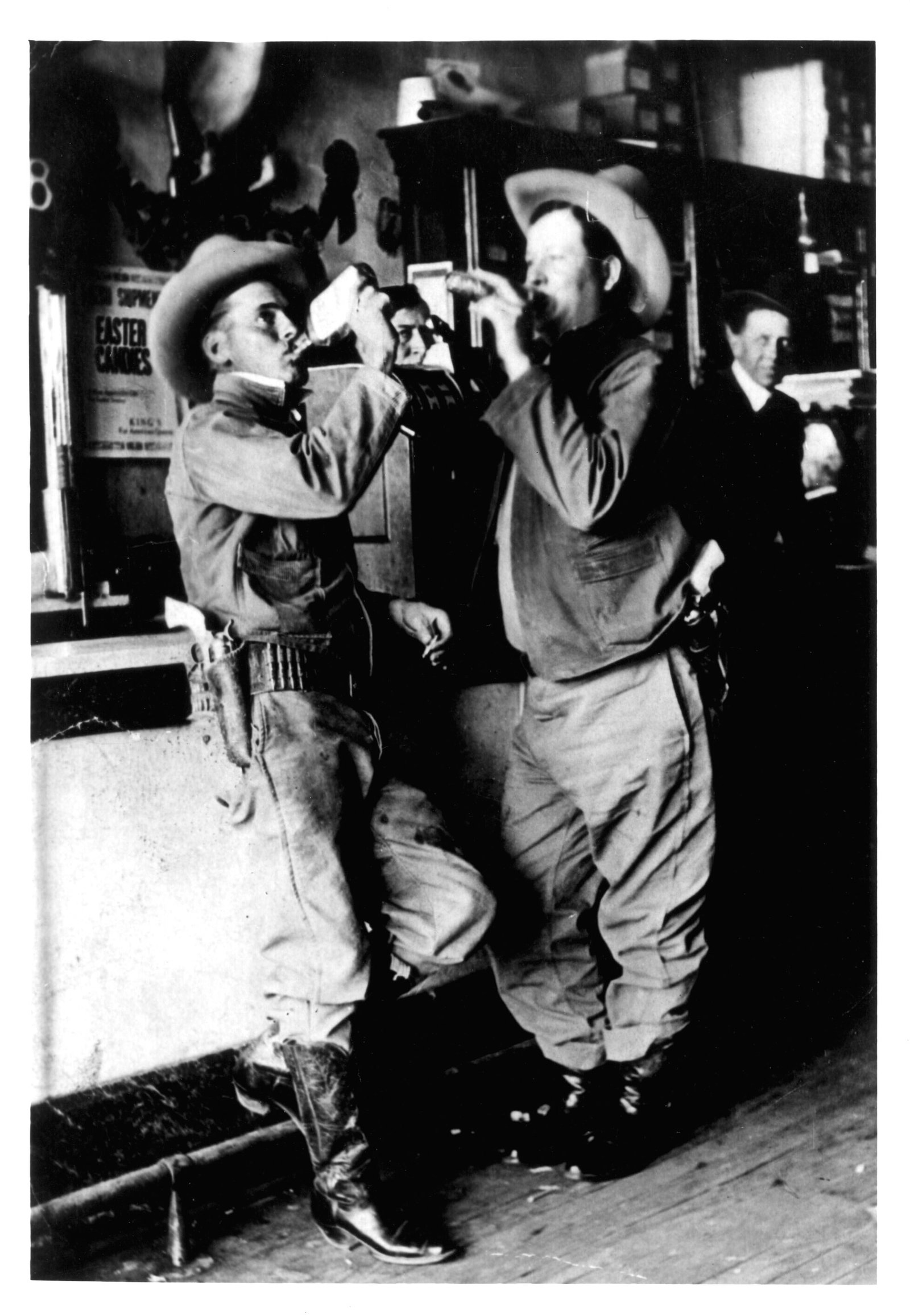
Because you’ve published items on Nate Fuller and A.G. Beard in your blog over the past couple of years, I thought you might enjoy the attached photograph of Fuller (left) and Beard pretending (?) to slake their thirst in an undated picture. My nephew, Caleb who lives in West Texas thinks he’s identified (the photo as being made at Livingstons's Ranch Supply in Marfa). As for the date, it would have to be sometime between mid 1916 when Beard and Fuller enlisted and 1920 when Beard left for Mexico. Obviously if you or anyone else could supply additional information it would be welcome.
Monty Waters
Monty,
Thanks for the cool old photo. A picture is worth a thousand words. Readers, for more on A.G. Beard from Monty, see:
http://www.rimrockpress.com/blog/index. ... 106-223008
Gj
[ 1 comment ] | permalink
EXCELLENCE IN WEST TEXAS HISTORY FELLOWSHIPS FOR 2010-2011. The West Texas Collection at Angelo State University in San Angelo, Texas, a member of the Texas Tech University System announced that applications are now being accepted for two fellowships of $40,000 to be awarded in April 2010. Application deadline is January 31. Fellowships are for a full academic year. In addition, a $5,000 publishing subvention will be provided to an academic press for each completed manuscript accepted for publication.
Research must focus on the western half of Texas and utilize regional archives. Applicants must be either finishing their doctoral work or with Ph.D. in hand in a field of the humanities. Fellows will be expected to spend the 2010-2011 academic year utilizing the regional archives in West Texas.
Applicants should send the following information:
· Curriculum vita
· Description of the research topic
· A sample chapter or extract of previous work
· Three letters of reference from individuals who can attest to the importance of the work proposed and to the ability of the individual to fulfill the stated goal.
Send applications to:
Excellence in West Texas History, ASU Station #11043, San Angelo, Texas76909
For more information contact:
Suzanne Campbell, West Texas Collection, 1910 Rosemont, San Angelo, Texas76909, Phone: (325) 942-2164, Email: Suzanne.Campbell@angelo.edu; URL- http://www.angelo.edu/services/library/ ... index.html
FORMBY RESEARCH FELLOWSHIP AVAILABLE, SOUTHWEST COLLECTION, TEXAS TECH UNIVERSITY. The Southwest Collection/Special Collections Library (SWC/SCL) has announced that Formby Research Fellowships are available that support short-term fellowships of 1-3 months. Applications are due on January 22. The fellowships carry a stipend of $2,000 per month and must be taken between June 1, 2009 and May 31, 2010. The funding is available to researchers residing outside the Lubbock area. Fellows are expected to be in residence and conduct research in the collections during the majority of the award period. Funding for the fellowships comes from the Sharleen and Marshall Formby Endowment.
SWC/SCL has research resources that include: the American West, ranching, agriculture, transportation, natural history and literature, politics, wind research, Texas music, military affairs, the financial planning movement, sports, water resources, oil production, and the environment.
Applicants should provide the following:
(1) cover sheet stating a) name, b) title of project, c) expected period of residence, d) institutional affiliation, e) mailing and email address, telephone numbers;
(2) a letter (not to exceed 1,000 words) which briefly describes the project, states the specific relevance of the Library's collections to the project, and indicates expected results of the research (such as publications);
(3) a curriculum vita or resume; and
(4) one letter of reference.
Address application or inquiries to:
Dr. Diane Warner, Chair,Formby Research Fellowships Committee, Southwest Collection/Special Collections Library, MS 41041, Texas Tech University, Lubbock, TX 79409-1041, Fax: 806-742-0496; Phone: 806-742-3749 ; Email: diane.warner@ttu.edu
Guides to the SWC/SCL holdings are available at the website: http://swco.ttu.edu.
[ add comment ] | permalink
The evening before he passed away, I had my last conversation with Elmer. I had stopped for a visit with him at the care center where he’d been undergoing rehab for about two months. He was propped up in his hospital bed, and as he shook my hand, he admitted to being “a little tired” from his exercise workout that day. His family was present, and after awhile our conversation turned to the evolution of his writing career. He told us he remembered he was paid one and a quarter cents per word for his first short stories. “It didn’t take long for me to figure that a twenty-thousand word novella was better than a five thousand word short story.” He talked about his earliest books published in paperback and how his first two novels – Hot Iron and Buffalo Wagons -- were also issued in a very limited run of hardbacks mainly for library distribution. He mentioned he was paid about $1,500.00 for those novels, “good money for those days.” And he remembered how elated he was when he entered the “big time” with the publication of his first major hardback, The Day The Cowboys Quit, in 1972. He recalled his relationships with his three major publishers, Ballantine, Doubleday, and Forge Press. And how pleased he had been with Forge. It was an engaging and enlightening conversation, with no hint of what was to come early the next morning. As I was leaving, he smiled, waved two fingers at me, and said, “Thanks for coming by, Felton.” A few hours later, he died peacefully in his sleep.
Elmer Kelton was the quintessential “good old boy” who truly appreciated his many fans. He was always willing, even eager, to sign a stack of books for a fan.
Some folks think he was just another western writer. Some who’ve never read his works inevitably ask if his books are “like Louis L’Amour’s?” They weren’t, of course. I tell people Elmer Kelton didn’t write ‘westerns’, he wrote western literature. When you open a Kelton novel, you know beforehand that it will be clean, historically accurate, and entertaining. And somewhere on those pages will be a subtle message. Sounds simple. But his writing was so much more than that. You’ll just have to read a Kelton novel to discover what I learned so many years ago.
Regretfully, he didn’t live to see the life-size statue of him that will be placed in the new Tom Green County Library sometime next year. His last public appearance was at the “Toast to Elmer Kelton” held in May at the Fort Concho Commissary. It was a catered event and all seats were filled—people showed up from around the state. At that event we presented he and his family with a bronze miniature replica of the statue and a bronze bust of Elmer. At least, he died knowing the statue is on its way to completion. And that it is being done by artist Raul Ruiz, who comes from a Tom Green County family that Elmer knew intimately for many years.
One of my life’s greatest treasures is a signed copy of the book he had dedicated to me – Texas Vendetta. The dedication page of that book reads: “To Felton Cochran, bookseller extraordinaire.”
I will always remember Elmer as “friend extraordinaire.”
Felton Cochran, 8/28/2009
[ 1 comment ] | permalink

Palacine Indian North, courtesy of www.oklahomahistory.net<http://www.oklahomahistory.net>

Palacine Station photo courtesy of Steven Harris, Ardmore, OK--collector of Palacine Indian Memorabilia

Photo of Indian sculpture, courtesy of Cinnamon Carter
In November 2008, sixth-grade reading teacher Cinnamon Carter challenged her students to investigate the history of Native Americans in their small West Texas community of Ballinger. Carter, a relative newcomer to the town, was surprised to learn that many of the students had collected photos and recollections of a long-lost Indian statue that had once graced a local park.
For nearly 20 years, “Chief Palacine” stood on Indian Hill in the Ballinger City Park. Ballinger city official Elmer Shepperd purchased the statue from the Wirt-Franklin Oil and Gas Refinery in Ardmore, Oklahoma, in 1939.
According to Shepperd’s nephew, the Ballinger statue was one of two from a Wirt-Franklin gas station at the southeast corner of Main and D Street Southwest in Ardmore. One statue was mounted atop the station and the other stood on a pedestal out front.
According to National Petroleum News (April 24, 1929), the Indian statues were an advertising ploy developed by D. A. Corcoran, head of Wirt-Franklin’s sales department. In order to get one of the 11 1/2-foot statues, gas station owners had to carry Wirt-Franklin’s Palacine gasoline and oil brands exclusively.
The cast zinc-alloy statues, produced for about $200 each by a Dallas sign company, depicted an Indian chief standing with one hand raised in a gesture of friendship. He stood on a cast metal “rock” over the words “A Friend.” The base displayed the words “Palacine - Motor Oil - Gasoline” on three sides.
While no one knows exactly how many statues remain, three have been on display since 1935 at Woolaroc Ranch, former home of Frank Phillips of Phillips Petroleum, in Barnsdall, Oklahoma.
A Wirt-Franklin employee named Eubanks reportedly hauled off 15 statues on Mr. Wirt’s orders, around 1952, and buried them in a ditch beside his house on Hedges Road, southwest of Ardmore.
The statue in Ballinger was stolen by vandals sometime in the 1950s. Legend has it that the chief was thrown into the creek below Indian Hill … “and never seen again.”
Carter’s sixth-grade class became fascinated by the Indian and the place that it held in their community’s collective memory. Family and wedding photos were often taken with “Friend,” and one woman said, “He was the holder of our secrets, because we knew he would never tell a soul.”
Carter, who recently established the non-profit Friends of Ballinger Indian Statue to raise money for the project, reports that the City Council, civic groups, and many individuals support the placement of a new Friend statue in the Ballinger Park.
Since January 2009, the students and the “Friends of Friend” have raised $14,000 of the estimated $47,000 needed to commission a bronze replica of Chief Palacine. The statue is being created by local sculptor Hugh Campbell, who specializes in Western art, and it will be cast in bronze by House Bronze, a custom fine art foundry in Lubbock.
Carter and her students continue to hold fundraising events and are beginning to look for grant funding opportunities. For more information, please visit http://www.ballingernews.com/friend.htm
Read what the Class of 2015 has to say about the project at http://www.ballingernews.com/studentletters.htm
If you would like to contribute to the project, please send your tax-deductible gift to Friends of the Ballinger Indian Statue, P. O. Box 231, Ballinger, Texas, 76821.
Steph McDougal
McDoux Preservation
[ 1 comment ] | permalink

(August 22, 2009) The prolific and highly respected Texas author Elmer Steven Kelton died in his sleep early this morning in San Angelo at the age of eighty-three years. Elmer was born April 29, 1926 on the Five Wells Ranch east of Andrews to Buck and Beatrice Kelton. He graduated from Crane High School and started classes at the University of Texas in 1942. In 1944, he put aside his studies to join the U.S. Army Infantry and saw combat in Europe during World War II. In 1947, Elmer married Anna Lipp of Edensee, Austria.
The couple returned to the United States where Elmer graduated from U.T. with a degree in journalism. Kelton worked as farm and ranch editor for the San Angelo Standard Times from 1948 to 1963 writing his first book “Hot Iron” in 1956. That same year Kelton penned “Buffalo Wagons” winning the Spur Award for distinguished writing of the Western Writers Of America. His 1973 “The Time It Never Rained” won the Western Heritage Award from the Western Heritage Museum in Oklahoma City. Tommie Lee Jones starred in and directed Elmer’s “The Good Old Boys” Turner Classic Movie. The Western Writers Of America named Kelton the number one western writer of all time. During his career, Kelton wrote sixty-two books and was the only writer to win the Spur Award seven times. He served as editor of Sheep & Goat Raiser Magazine and associate editor of Livestock Weekly for many years. At the time of his death, Elmer has two books “Other Men’s Horses” and “Texas Standoff” that are to be published posthumously. Even though Elmer has been ill for several months he was working on and hoped to complete a new Hewey Calloway “Good Old Boys” story.
Anna Kelton, his wife of sixty-two years, sons Gary Kelton of Plainview and Steve Kelton of San Angelo and daughter Kathy Kelton and their spouses survive him. Elmer and Anna have four grand children, five great-grandchildren and one great grand child. In lieu of flowers, the family requests that donations be made to a favorite charity, or to the Tom Green County Library Elmer Kelton Statue Fund at the San Angelo Area Foundation, 2201 Sherwood Way, Suite 205. Elmer Kelton's funeral is to be held Thursday at 2:00 pm at the First United Methodist Church, 36 E. Beauregard, in San Angelo.
[ 2 comments ] | permalink

Charles H. Harris III and Louis R. Sadler have given us a history tour de force with their new book “The Secret War in El Paso: Mexican Revolutionary Intrigue, 1906-1920”. Published by University of New Mexico Press, this recently released 488-page study is much more than simply an El Paso history as the title suggests. It is Texas history and Mexican history skillfully blended with U.S. diplomatic history as well. Secret War is for anyone interested in the Texas border and the Mexican revolution in those dangerous but intriguing times. The 107 pages of notes, bibliography and index is a valuable scholarly resource by itself. The research in Secret War is stellar and the book is so well written it is impossible to discern that two writers actually penned it. Secret War isn’t one of those books the reader cannot put down before finishing. When I picked up my copy at Cactus Book Shop in San Angelo, I told Felton Cochran I would read it and have a review posted in a few days as is usually the case with a new read. Two weeks and more than one yellow highlighter later, I finished Secret War and find it not easy to express how impressed I am with this work. Perhaps I should simply say I think it the best and most finely detailed Texas-Mexican history I have ever read.
Secret War is fascinating with all the exciting elements of a world-class work of fiction but this is not an invented story. Here you will find real Texas Rangers, Federal agents, inventive smugglers, filibusters, spies and counter spies, traitors, thieves and murderers, gunrunners, secret codes, counterfeiters, shyster lawyers, and Mexican revolutionists from Victor Ochoa to Pancho Villa. It should be the goal of quality historians to interpret the past to the issues of today and inform the reader of why the past cannot be ignored. In this, Harris and Sadler truly demonstrate their work to be outstanding.
While the book offers an impressive bibliography, one most important collection of documents in the National Archives has finally emerged as being vital to the study of Texas and the Mexican revolution. This is RG 65, the Records of the [Federal] Bureau of Investigation, 1908-1922. It contains some 80,000 pages of documents.
I first encountered these documents many years ago when I had the opportunity to do some research at the National Archives in Washington, D.C. Thanks to some funding from the Permian Historical Society, I went to D.C. in 1988 to research the records of the Big Bend Military District in RG 391, the Records of the United States Army Mobile Units 1821-1942. These include the official reports and records of the U.S. Cavalry stationed in the Big Bend during the so called “bandit raid” years. In the first few days of my D.C. research, I went through the Big Bend records in some ten or so boxes and made copies of those things I found of interest. But keep in mind, these are the official records that include things like troop movements and dates, logistical records such as the construction of the border outposts, and returns and casualties. My gut said there must be more and thanks to the advice of a astute archivist, I traveled to the Washington National Records Center in Suitland, Maryland. It was here that I found the classified and secret documents concerning the U.S. Cavalry actions in the Big Bend. At the time, many of these documents were classified even though more than seventy years had passed. While I was permitted to read most of these documents, each individual piece of paper I wanted to copy had to be examined and declassified by a military officer. The first day, a U.S. Army Captain only approved for copy a very few documents probably because he didn’t want to make things known that might be embarrassing to the army. My luck changed the following day when a U.S. Navy officer approved everything I found. I came back to Texas with two suitcases full of documents that have been the basis of my research of Big Bend military since that time.
Over the years, I have made every effort to encourage our Texas universities and archives to obtain the now declassified and available on microfilm RG-65 for study. Usually the only response I get is a blank stare from a professor or archivist who explain there is no funding available for such and must have thought, what is he talking about? Harris and Sadler have made it obvious they have access to RG-65. I know of no institution in Texas that has or is interested in RG-65.
“The Secret War in El Paso” is in stock and available at Cactus Book Shop in San Angelo and Front Street Books in Alpine. For more information or to purchase Secret War go to:
http://cactusbookshop.com/
http://www.fsbooks.com/
Gj
[ add comment ] | permalink
Dear WTHA Board members and friends,
Tai (who is temporarily out of the office) has asked me to contact you and let you know that our esteemed friend and dear colleague Professor Fred Rathjen passed away, apparently of liver cancer, yesterday around 2pm. Member Christena Stephens passed the word to me and Tai from member Brenda Haes. Fred evidently had been under Hospice care for about a week. I know that this is yet another shock to our Association, especially on the heals of the recent news about two other of our giants B.W. Aston and Elmer Kelton.
Our Year Book review editor Jean Stuntz sent along the following relating to wishes from the family. Jean has promised to send along additional information about potential services as soon as she hears of something.
Fred Rathjen’s family wants any memorials to be given to the Forman/Rathjen scholarship which Fred created years ago. People can give online at https://mercury.wtamu.edu/wtfoundation/ or by mail to WTAMU Foundation, WTAMU Box 60766, Canyon, TX 79016, or by calling (806) 651-2070. They can designate the Forman/Rathjen scholarship when they donate.
David Murrah just sent the following as I was crafting this letter:
I just talked to Fred Rathen’s son Kurt.
The graveside service will be at 9:30 am Thursday at the St. Paul Lutheran Cemetery on the Palo Duro Canyon highway in Canyon. The memorial service will be at the Trinity Lutheran Church, 5005 W. I-40 (between Bell and Western on south side of I-40) at 11:00 am Thursday.
David Murrah
I'm sure each of you join us here at the headquarters in sending our deepest sympathies to Betty and the family. I will keep you posted and will send a general announcement to the membership when I gain access to the email list.
Monte
====================================
Contact Information:
Monte L. Monroe, Ph.D.
Southwest Collection Archivist/Adjunct Professor
Texas Tech University
Southwest Collection/Special Collections Library
Box 41041
Lubbock, TX 79409-1041
(806) 742-3749 WK
(806) 742-0496 FAX
monte.monroe@ttu.edu
For more on Dr. Rathjen see:
http://www.amarillo.com/stories/072209/obi_obit23.shtml
Gj
[ add comment ] | permalink
I am an avid reader of on line Texas newspapers and greatly missed seeing the Big Bend Sentinel being available. Some months back when the Sentinel put together their great new web edition, they changed their internet address and I assumed they were no longer on line since their old URL no longer worked. My mistake. The Sentinel is back and so much better. To read the new Sentinel just use:
http://www.bigbendsentinel.com/
Gj
[ add comment ] | permalink
Hi,
Can you tell me anything about Judge Edwin H. Fowlkes? He was a friend of John Prude's. He had a ranch and a home around Ft. Davis. He named one son after John Prude and another after Dr. Coleman. Any help would be appreciated.
Thanks,
Lynda
Lynda,
See:"History Of Marfa And Presidio County" by Cecilia Thompson. Much must have come from "Marfa New Era" that burned sometime in the 1930's. It is obvious Ms. Thompson has or had some surviving copies. Barker Texas History Center in Austin has a few years of New Era on microfilm. I am sure New Era has articles about the judge, if you can find them. Also search newspapaperarchive.com. Several articles there. Don't overlook Archives of the Big Bend, Sul Ross, Alpine. They probably have a file.
Gj
[ 1 comment ] | permalink
On Saturday, July 4, 2009, 10:23 AM, Felix Boniulla Salmeron wrote:
I am amased at the lack of history in the West Texas region. I am a desendent of the Benavidez-Ortiz-Bonilla families of the Van Hron, Valentine, Ruidoso, Ft Davis, Alpine Toya Kent areas. Muy Great Grandmother was born in Valentine Texas in feb 1883 and Married Antonio Bonilla in 1895. They wnet on to rais e a big family. That is only one side of the family. Nestora's parents were Juan Benavidez and Petra Ortiz whoi lived in the Van Horn area early on. We have had a long tradition of veterans from WW1, WW2,Korea, Vietnam and now in Iraq. Muyy great Grandfather owned Mules which he usedwhen he worked on the rail road to move cross ties for the rail road. His son's were leneros or wood salemen as they gathered and cut wood to seel in Ft Davis in the early 1900. Back min those days, there was no electricity to go around or fuel for heating. Everyday they would go to the mountains and gather wood for sell to the people in the Ft davis town. They later got married and started families which now reachs into the 2000 mark. I have enjoyed you information and wish that there was more on the impact that hispanics had in West Texas
[ add comment ] | permalink
Hello,
I am Joe Sitters great granddaughter, Sylvia. I would also like to receive a copy of the photo of my great grandfather.
I would be more than happy to pay for any printing and shipping costs!
Thank you for all you are doing!
Sylvia Sitters
Sylvia,
Sorry I took so long on this, have two books on the burner and it took me a while to find the photo in my files. I am emailing you a jpeg. Joe Sitters is on the left, Jack Howard standing next, unknown person next and Luke Dowe on the right. Photo made in front of Presidio County Court House, sometime before 1913. This is the photo third from the left at the top of the blog. Im writing a chapter about Joe Sitters in my forthcoming book, “More Little History Of The Texas Big Bend” and really need copies of any other photos or documents the Sitters family may have or know of.
Gj
[ add comment ] | permalink
On Friday, June 26, 2009, 04:48 PM, David Tiller wrote:
Glenn,
I am very interested in finding the grave site of my Great Grandmother Jettie Smith who was related to the Prude Family and lived in Ft. Davis until her death around 1988. I believe that she was buried in Marfa. I can find no death records of her and remember her 100th birthday party at the Prude Ranch. To be honest, I'm not sure that her first name was Jettie or if that was her proper first name. She lived for many years at the Hotel Limpia. Any information you may have would be appreciated. Thank you, David Tiller
David,
You must know your Grandmother's full name, when and where she lived to start. Smith can be very hard to trace. Ancestry.com is great for this sort of thing. Maybe John Robert can help. Seems like I remember Big Spur mention Aunt Jettie once.
Gj
[ add comment ] | permalink
On Tuesday, June 30, 2009, 07:39 PM, Derrick Perrin wrote:
I found your story on line about the old ranch and rail line near Valentine. Do you have any other information on the location. I love the history of the area and I am in search of stories about the area.
Thanks
Derrick Perrin
Derrick,
My "Englishmen, Railroads and the San Carlos Coal Mine" is to be published in the Journal Of Big Bend Studies" in the fall. Also is a chapter in my forthcoming book "More Little Known History of the Texas Big Bend".
Gj
[ add comment ] | permalink
Elmer Kelton was released on Thursday from the hospital, is on oxygen, & had a fall in the bath room. He has great difficulty in breathing while fighting pneumonia and other serious ailments He had to go back to the hospital on Friday as could hardly get a breath.
He thinks, after wanting to be "at home," that this time he will try going to a nursing home for a while & perhaps with round the clock care he can gain strength and then go home. I do hope this works out as he himself said, he must get well as he has another book to write & has already done the whole outline. That's forward thinking, looking to the future which I think is half the battle-now if the doctors will try hard to get him well then all will be well. I will send address of Nursing Home when I get it.
We must keep the prayers going and God will answer them. I will try to keep all posted and each of you can share the news with those whom I did not e-mail for lack of address. I know he will appreciate cards & telephone calls.
Peggy
[ add comment ] | permalink

I recently picked up and read your book Cattle and Dudes... a most enjoyable read. My reason for picking it up was because I am interested in John and Amanda Prude, so I found myself quickly turning to Chapter 4 and trying to learn more about this couple. The reason for my interest is that I am descended from them through their elder son, Claiborne Gentry Prude.
I would like to comment however on some of the information presented about John and Amanda Prude. prior to them relocating to McCulloch Co. from Colorado Co., TX. I have spent a lot of time tracking this family between 1850 and 1880 and I'd like to offer some of that information to you as follow up to what you presented in Cattle and Dudes.
As best as I can tell John Prude was the first person with the surname Prude in Louisiana (De Soto Par). He is listed as a single man in the 1850 federal census as a laborer in the household of Thomas Weaver. For the last 10 years or so, I have debated whether or not this John Prude was the John Prude that came to Texas. Whether he moved there as you say to follow a relative, I have no idea. A 2nd or 3rd cousin does move to Louisiana and is listed in the 1860 census, but during the 1850 census is located in Pickens Co., AL. The children of this cousin do relocate to Texas in and around Ellis Co. sometime later (after 1870). In any event, John in 1850 is a single man having left his family in Pickens Co., AL to arrive in Louisiana by 1850 and then quickly departs for Texas sometime between 1850 and 1851.
In 1851, on Nov 26th, John Prude marries Amanda Jane Maxwell of Fayette Co., TX. Amanda Jane Maxwell is the daughter of Thomas Maxwell who arrived in Texas about 1834. Thomas Maxwell served as a private under William Kimbro during the Battle of San Jacinto and for his services he was given a League and a labor of land which was on the shores of Plum Creek in Gonzales Co., TX. (now part of Caldwell Co., TX). He was also granted 320 acres of land in Fayette Co. for having served in the Texas Army. He sold a quarter of his League and labor to Josiah O'Daniel (his brother-in-law). Josiah died before ever receiving the deed and when Thomas Maxwell died intestate in 1852, the estate of Josiah O'Daniel was suing the estate of Thomas Maxwell for the deed (I must admit here, I don't read legalese all that well, but I think I got the gist of the precedings of the probate court). In Dec of 1852, the wife of Thomas Maxwell, Elizabeth died and it's here we see the first mention of John Prude in the probate records of Fayette County. John Prude is serving as surity for the administrator, George Dismukes, of what is now the Thomas and Elizabeth Maxwell estate. George Dismukes is Amanda's brother-in-law via her eldest (known) sister.
So in brief, 1851ish, John shows up in Fayette Co., marries Amanda, and is quickly embroiled in the probate affairs of the Maxwell estate.
John appears in the tax lists of Fayette county beginning in 1852 through 1856. By 1859, John Prude is found on the tax rolls of Colorado County. In 1860, The Prudes are listed in the 1860 census for Colorado County. Their eldest son Thomas (presumable named for Amanda's father) has died of typhoid (Jun 1859) and the youngest of the orphaned Maxwell children is living in the Prude household. The enumerator for this census, completely misspells their name as "Boreds". From 1859 through 1878, the Prudes reside in Colorado County and nearby Lavaca county. During the civil war, John Prude and the orphaned son of Thomas Maxwell, Robert G. Maxwell, enlist in a reserve company of the Confederate Army known as the Colorado Grays. Other research suggests that Robert G. Maxwell enlisted and served in the 27th Regiment, Texas Cavalry (Whitfield's Legion) (1st Texas Legion), Co D. Entered as a Private and Ranked out as a Private and promptly disappears from the record. As best as I can tell, the Colorado Grays never saw any action and it's highly unlikely that John Prude did anything other than serve as a militia force for ColoradoCounty.
Sometime between 1878 and 1880, the Prudes relocate to McCulloch County where I lose their specific trail to the Davis mountains and southern New Mexico, other than land grants here and there and the gravesite in Weed, New Mexico. In fact I often wondered why Weed? I've visited the site and I can certainly see the appeal of the east New Mexico prairie (Is that still Llano Estacado?). But it never made sense to me why they would leave the Davis Mts., unless it was a second feeding ground. My ancestor, Claiborne Gentry Prude, John's elder son, planted his family in those mountains about 1884 (the time of the big cattle drive) and maintained a ranch southeast of Weed for three generations. In fact, Claiborne's first wife Tennessee Donathan is buried in the same plot underneath that big pine next to Amanda Jane Maxwell Prude in the Weed Cemetery.
John Prude died in 1893 and was buried in Mitchell Co., TX. (I presume he died in Mitchell Co., as well.) His stone can be found in the Colorado City Cemetery.
Anyway, that's the history as I've discovered it. Most of the documents I used were the probate and tax records of Fayette and Colorado County census and land grant records. I still need to scour the earlier Colorado County records and the Gonzales County records for a few more details, but don't have as much time as I would prefer to do so.
I really appreciate your book, it's a fascinating story and really filled in the gaps of the more recent history for me. The sad thing is, I grew up in El Paso, have made many trips to Big Bend, had friends and neighbors that went to summer camp at the Prude Ranch and I have never even visited much less contacted any of my distant cousins
I do have two questions for you. The first is in regards to those persons in the Prude picture found on the cover of Cattle and Dudes. Do you happen to know who all the people are? Is the man sitting in the middle with the beard John Prude (above)? Second, is there anyway I can get a decent copy of that picture be it through the Jeff Davis Archives or some other source? My second question is concerned with reference #174 in your text. Where did you get a hold of a copy of that genealogy text. When I was about 15, a copy was shown to me by my grandmother, but it was quickly returned to it's original owner. I have searched high and low for a copy to examine and short of visiting the Alabama State Archives or the Library of Congress, it is not likely that I will ever see that ancient family history book. Is that a book in the possession of the Prude family or is that found in the archives of Jeff Davis County or something in your own private collection?
Maybe some day, you might be interested in hearing about some of my other ancestors, in particular the Casners, one of whom served as a Texas Ranger and also served in the Texas War of Independence. He sold his League and labor for a horse and saddle. Palm + forehead. Several members of that family wound up in Brewster and Presidio Counties. My direct ancestors moved west to New Mexico.
Chad Wayne
Chad,
I believe Andrew G. Prude to be standing fourth from the left in the above photo. Sorry I do not have a better print in my files and the photo had no original captions. The genealogy text mentioned came from John Robert Prude. Suggest you contact him for a copy. Also, I did several oral interviews with John G. Prude and some years ago donated all of my Prude files and the interviews to Archives of the Big Bend at Sul Ross University in Alpine. Perhaps they can help in your research. If memory serves me correctly, you will find some of the tapes mention the Weed, N.M. Prude relatives. John G, John Robert and I made a trip to Weed and the Prude ranch and graveyard where John G. told the story of that branch of the Prude family on the tapes. Not sure if the tapes have been transcribed.
Gj
[ 4 comments ] | permalink

FIRE BURNS ON WESTWARD SLOPE OF SIERRA VIEJA

LOW FLYING SINGLE ENGINE PLANE SCOUTING AND SPRAYING THE FIRE IN MUSGRAVE CANYON
(Candelaria, Texas, 12p.m., 5-14-09) A large fire is presently still burning in the Sierra Vieja as aircraft continue to drop fire retardants this morning. The fire, said to have been started yesterday by “illegal aliens trying to block their pursuers.” Early this morning the fire crossed over the rimrock heading westward and continues to burn about 16 miles west of Valentine. From below the rimrock, the fire appears to be a little south Viejo Pass and is burning in a fire front perhaps a miles wide as it sweeps over the mountains. Moderate but gusty winds, especially in the higher elevations, are spreading the fire into Musgrave Canyon below the rimrock. The fire seems to be spreading out of Musgrave Canyon in spite of efforts to extinguish it. Atop the rim, firefighters are using larger aircraft and bull dozers to fight the fire. The Presidio Valley above Candelaria is filled with smoke. I approached the fire it started to crest over a hill a few miles away. Since the fire was burning in my direction with the wind fanning the flames as two small aircraft dropped fire retardants in the nearby canyon, I decided it best to retreat.
Gj
[ 1 comment ] | permalink
A recent book by John G. Sotos, M.D. poses some very interesting historical questions about the 16th President of the United States. In “The Physical Lincoln” published last year, Dr. Sotos suggests President Abraham Lincoln was suffering from terminal cancer and would have died from the disease within a year of his assassination. Dr. Sotos is attempting to persuade the Grand Army of the Republic Museum and Library in Philadelphia to allow DNA testing of a sample of Lincoln’s blood on a pillowcase in the museum’s collection. Why is this important? See the below links:
http://www.physical-lincoln.com/index.html
http://www.physical-lincoln.com/importance.html
http://www.physical-lincoln.com/books.html
Gj
[ add comment ] | permalink
Thursday, February 28, 2008, 04:24 PM
Glenn,
I am researching some family oral history which occurred in Presidio, likely in the summer of 1917. I am looking for a newspaper/official account of this event. Can you suggest some directions/web sites?
Regards,
Hugh Fletcher
In the summer of 1917, Presidio County deputy sheriff John Fletcher Rawls, a rancher in the Casa Piedra area of Presidio County, Texas was wounded in a shootout in the Anaya Cafe on Main Street in Presidio , Texas. The gunmen were renegade members of the US Army who were protecting the border against Pancho Villa. Rawls, commissioned by Sheriff Ira Cline, of Presidio County, Texas was the only lawman in the immediate area and alone, challenged the band of seven armed men when he discovered them in a back room of the cafe with the waitresses who had been taken prisoner for sexual purposes. The waitresses were daughters of the owner, part of a family that had taken refuge in Presidio to avoid the revolution that was taking place in Northern Mexico, particularly in their home state of Chihuahua. When Rawls opened the door to the back room the shoot out began. Rawls tripped on the step to the room which was raised above the ground floor level of the main floor, and as the shooters ran past him, as he scrambled to get up off the floor, they unloaded their service pistols into him, escaping but leaving the girls unharmed. They were never identified or tried as their identities were never known. Somehow Rawls lived, although severely crippled. After a year of hospitalization with a huge amount of doctor bills, Rawls sold his ranch and moved to El Paso, Texas He died in Austin, Texas Dec 21, 1958. After the revolution, the Anaya family returned to their home in Chihuahua.
Hugh
The following is a response to the above account from Monty Waters:
Glen,
You published e-mail from Hugh Fletcher in February 2008. He sought more information on a shoot out involving his grandfather in Presidio Texas. I have since spoken with Hugh Fletcher and his son Tyler (of Fletcher’s books in Salado). I have done more research into the career of my grandfather, A. G. Beard, a law enforcement officer in Presidio County from 1916 to about 1920. I think the story of Fletcher Rawls and my grandfather are connected, beyond the fact that they were both law enforcement officers at the same time and in the same place, though I’ll admit I can’t prove it. Written below is what I do know. I won’t try to attach or insert footnotes here but unless otherwise indicated, all of my information comes from documents and published sources I have reviewed.
I can provide a bit more detail on the events described in Hugh Fletcher’s e-mail about his grandfather’s brush with death. First, this probably did not happen in 1917. He dates it as during the tenure of Presidio County Sheriff Ira Cline, who did not take office until 1918. Cline served until 1921 after losing the 1920 election to Jeff Vaughn. His grandfather, Fletcher Rawls served both Cline and his predecessor, Milton Chastain as deputy for many years and was certainly involved in the violence of the times. The Alpine Avalanche published a story on October 14, 1914 with the following headline: “Fletcher Rawls killed Marin Dominquez, a bad and treacherous Mexican, at a dance held at the Rock House.” The “Rock House” (aka Casa Piedra) was very near Rawls’ ranch in southern Presidio County. Sheriff Chastain, in May 1917 recommended Fletcher, his brother Tom and his nephew (Tom’s son) Jack for “Special Ranger” commissions, which could usually be obtained by having the local sheriff request them from the governor. Chastain cited the Rawls’ proximity to the border as the reason for their request, and also cited Fletcher Rawls’ nine years of service as a deputy to him. Governor Ferguson granted the request and all three Rawls got commissions, which allowed them to carry firearms openly, and assist the local ranger company when needed, though they were not on the state payroll. Ultimately these commissions were surrendered when a new governor and new adjutant general took over in the wake of Ferguson’s impeachment, and only Tom Rawls bothered to renew. This is probably because the other Rawls received or resumed their commissions as Presidio County deputies and didn’t need them.
Hugh Fletcher wrote that the incident occurred in the summer. His son Tyler remembered his great grandmother telling him she was in class and was called out and told something terrible had happened to her father. He thought it was during the school term. For reasons I give below, I think they were both correct, and the incident happened in May of 1919.
Hugh told me that his grandfather borrowed a new holster from his nephew Jack, before the incident, and his gun stuck in his holster, making it impossible for him to draw his weapon. This explains the lopsided outcome of the gun battle. He also told me his grandfather’s interest in the woman in the café was not entirely professional. He thought his grandfather, single at the time, was sweet on one of the women who worked there. He asked his grandfather what happened to the men who committed this act of violence against him and was told that they “were taken care of by friends,” and wouldn’t elaborate.
On August 5, 1919 my grandfather, A.G. Beard, Charlie Craighead, and Jack Rawls were indicted by the Presidio County grand jury for “robbery with firearms, assault to murder . . . [and] threat against life and false imprisonment.” My grandfather had been honorably discharged from Jerry Gray’s Marfa-headquarted company of rangers in March 1919, and sometime thereafter he took a job as town marshal of Marfa. Charles Craighead, another former ranger, had a long and “colorful” career in Texas law enforcement. He was a son of a former Wilson Co. sheriff, brother to ranger Pat Craighead who lost a leg in the “San Benito shootout” in south Texas that took the lives of a deputy sheriff and ranger. Charles Craighead, shortly thereafter took the life of a Mexican suspect, for which he was indicted and acquitted on grounds of self-defense. In 1915 he was involved in the shootout with members of Chico Cano’s gang that took the lives of Eugene Hulen and Joe Sitter. As of May 21, 1919 he resigned a position as an inspector for the Texas Cattle Raisers Association, and the special ranger commission that went with it, to become a Presidio County constable. Jack Rawls was 21 years old, had recently married and become a father. He was the son of Tom Rawls, a prominent Presidio County rancher and county commissioner. His involvement in a violent escapade with two veteran law enforcement officers seems out of place unless, as I assume, it was directed against parties he blamed for his uncle’s wounds.
But I know very few facts about what caused these indictments to be issued, aside from what is written in the grand jury report. All of the files concerning it are missing from the Presidio County courthouse except a few entries in court minutes, which are summarized below. The incident obviously happened sometime prior to August 1919. The grand jury mentioned that crime, and “lewd women” were a problem in Presidio County. It also chastised local law enforcement officers for taking the law into their own hands, instead of reporting criminal activity to the grand jury. This remark suggests that the victims of the violence were not entirely upstanding citizens.
Beard family folklore suggests that A. G. Beard got in trouble for using too much force in shutting down a local business that my 100-year-old cousin has variously described as a “gyp joint” or a “house of ill repute”. The owners were influential and caused him to lose his job as marshal (the indictment is not mentioned). Could these assaults relate to the Anaya café?
There is one other tantalizing clue. In ranger force Special Order 21, which announced my grandfather and others were to be honorably discharged in March, they were specifically made eligible for future service should openings occur in the force. By April Gray’s company was again recruiting rangers, and it is likely my grandfather tried to re-enlist. I infer this because on May 24, 1919 Captain Gray wrote to his friend, Captain Roy Aldrich in Austin (who would need to approve any reenlistment) a cryptic letter, which said “This is on the Q.T. Don’t have beard [sic] put in my company until you see me personal. There has ben [sic] something doing out here.” After his signature Gray wrote “Destroy this don’t file it away.” I suspect the “something” Gray referred to was the incident that caused Beard, Rawls and Craighead to be indicted two months later.
In addition to the indictment, in August Beard, Craighead and other ex-rangers and law enforcement officials became suspects in a July 30th robbery of a Mexican payroll officer of $21,600, mainly in gold coins. No one was ever indicted for this robbery, but the suspects are all identified in internal [federal] bureau of investigation documents examined by historians Sadler and Harris. The other suspects included Sheriff Ira Cline, his brother Buford, prominent local rancher Jesse “Buck” Pool, ex-rangers Boone Oliphant, and Andy Barker (nephew of long time Presidio sheriff Dud Barker). The last three were all participants in the 1918 “Porvenir massacre”.
If Craighead and Beard did share in the proceeds of this robbery, they would need it for bail and lawyers. Charges were eventually dropped against Jack Rawls. Craighead spent part of this period in Hebbronville where his brother was by now sheriff. After lengthy delays he pled guilty, in 1921 to a charge of aggravated assault. The record does not disclose what sentence, if any, was imposed on him.
My grandfather A.G. Beard never stood trial. All we know for certain is that in early 1920 he was still living in Marfa and told the census taker that he was employed as a peace officer. But by the spring of 1922 we know he was working as security for an American oil company in Tampico, Mexico. It is probably not coincidental that the ex ranger captain under whom he served for two years, James Madison Fox, was also employed there. Fox resigned from the rangers in June, 1918 following the firing of five of his men for their actions at Porvenir. Fox held a variety of jobs until he returned to the rangers as a captain in the mid 1920s under the patronage of the newly elected Miriam Ferguson.
As noted by Hugh Fletcher, the injuries to Fletcher Rawls ended his career as a Big Bend rancher, but his brother and nephew continued to ranch there until the 1950s. Beard eventually returned to Texas, and in 1923 married my grandmother. He died in 1941 and is buried in Austin. Charlie Craighead resumed a career with the Cattle Raisers where he served many years. He died in Hebbronville in 1951. In the late 1950s the Texas Legislature funded a pension for rangers of their era and both Beard’s and Craighead’s widows received ranger pensions until they died.
Thanks for the update Monty. Unfortunately no microfilm exists of the Marfa New Era newspaper of those days since it burned in a fire sometime in the 1930's. The El Paso Public Library has microfilm and an excellent index of the El Paso Times which may contain some info about the shoot out. Newspaperarchive.com also has El Paso Times. Gj
[ add comment ] | permalink

Our dear friend and colleague Gerald Raun passed away March 25, 2009 in Alpine, Texas. He will be greatly missed. Services are to be announced later. Gerald Raun was born July 14, 1932 in Maryville, Missouri. After living in Lincoln, Nebraska, San Francisco, California and Tulsa, Oklahoma his family moved to Odem, Texas, where he graduated from high school in 1949.
Gerald enrolled at the University of Texas at Austin in 1956 and received an M.S. in Zoology in 1958 and a Ph.D. in Zoology in 1961. His thesis was an ecological study of the terrestrial and aquatic vertebrates of Palmetto State Park, a moist, relict area in Central Texas. He was awarded a Welder Wildlife Foundation Fellowship and spent three years at the Welder Wildlife Refuge near Sinton, Texas, where he completed the fieldwork for his dissertation, a study of the population dynamics of the wood rat, Neotoma microus.
Gerald was appointed Curator of Zoology at the Texas Memorial Museum in Austin, in 1960, where he served until accepting an appointment as Assistant Professor of Biology at North Texas University in Denton in 1967. He was promoted to Associate Professor, and in 1970, moved to Angelo State University in San Angelo as Professor and Head of the Department of Biology. He remained at Angelo State until 1978 when he resigned and entered private business.
He became involved in advertising, including positions with the San Angelo Standard Times and the Thrifty Nickel. He became publisher of the Devil’s River News in Sonora, Texas and in 1989 moved to Alpine as publisher of the Alpine Avalanche. He retired in 1993 and returned to research interests including Trans-Pecos cacti and the history of the Big Bend, particularly as affected by the Mexican Revolution 1910-1920.
Gerald served for almost ten years as Editor of the Texas Journal of Science and was a Fellow and Honorary Life Member of the Texas Academy of Science. He held offices as Secretary, Vice President, and President of the Texas Herpetological Society. He was a member of the Board of Scientists, Chihuahuan Desert Research Institute, the Advisory Council of the Center For Big Bend Studies, and also served on the Center’s Editorial Advisory Board. He was an adjunct Professor of Biology at Sul Ross State University and served on the Alpine City Council.
He authored two books, one book chapter, several monographs and over 50 scientific articles dealing with amphibians, reptiles and mammals of Texas, and more recently on cacti. He has also authored several historical articles, which have been published in the Journal of Big Bend Studies. In 1997, Raun completed an index for the Journal, and most recently he completed another index for the publication (volumes nine through nineteen) to be published later this year.
Condensed and edited from “Spotlight on Gerald and Dian Raun,” in La Vista de la Frontera—Newsletter of the Center for Big Bend Studies, Summer 1997, Sul Ross State University.
[ 2 comments ] | permalink

Random Entry